
This 16-Month-Old Has Visited More National Parks Than Most Adults. Maybe We're Thinking About Family Travel All Wrong.
A 16-month-old's journey through America's national parks challenges the way we think about family travel. Discover why children don't need to remember every trip for it to matter—and how nature, curiosity, and shared experiences create memories that last a lifetime.

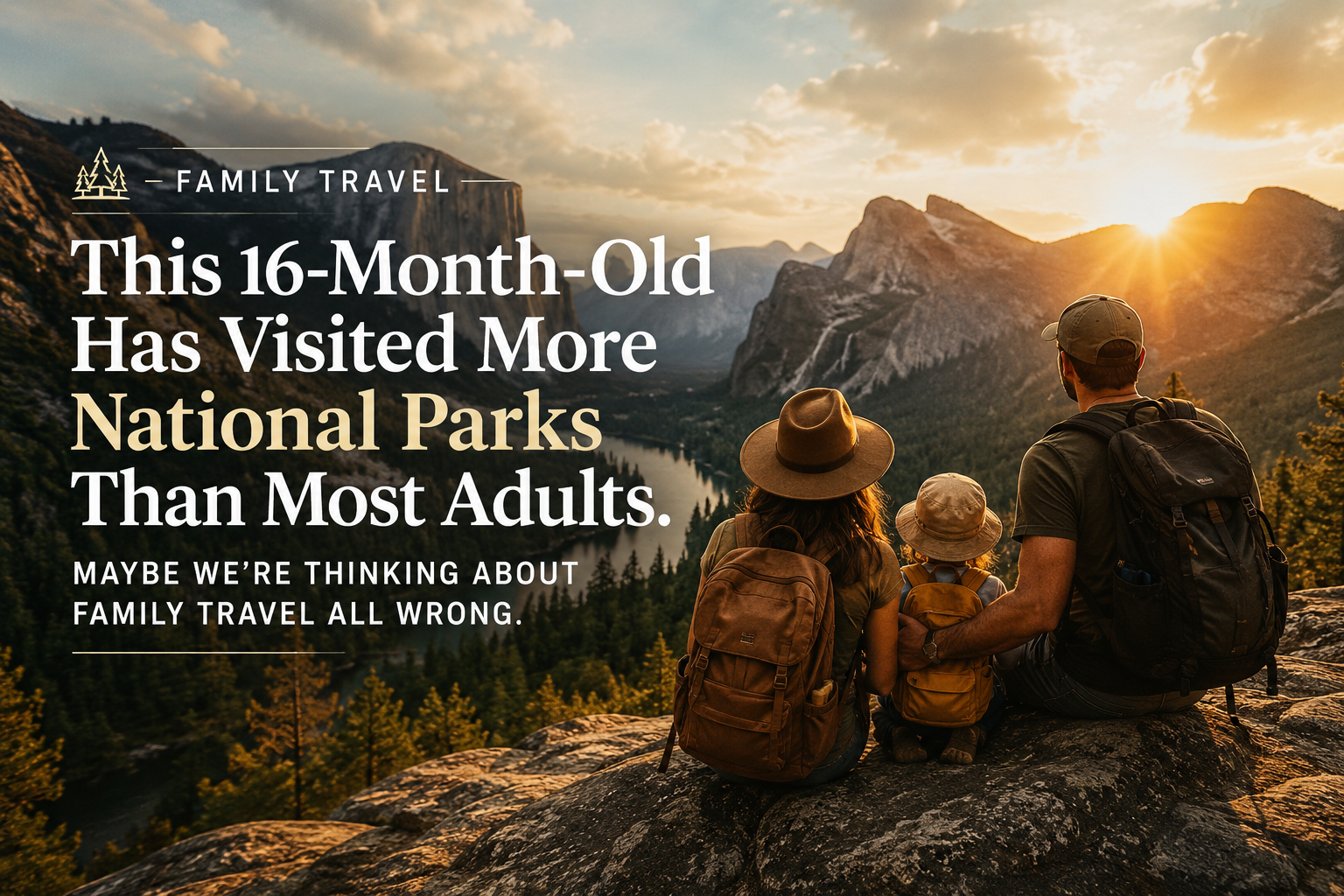
"Sometimes, the smallest travelers remind us of the biggest truths."
Aarya Sharma is only 16 months old.
She probably won't remember standing beneath the towering redwoods of California.
She won't remember the mist rising from Yellowstone's geysers.
She won't remember the endless skies above Utah's deserts or the winding roads through the Great Smoky Mountains.
Yet she has already visited 34 of America's 63 National Parks, and her family hopes she'll become the youngest person ever to visit all 63.
When I first read that story, I expected to admire the record.
Instead, it made me question something much bigger.
When did we start believing that children have to be older before they can truly experience the world?
We Often Wait for the "Right Age"
Parents hear it all the time.
"They're too young."
"They won't remember it."
"Wait until they're older."
It's practical advice.
It sounds reasonable.
But what if we're measuring travel the wrong way?
We assume the purpose of family vacations is to create memories children can recall decades later.
Maybe that's only part of the story.
Perhaps travel isn't just about the memories children keep.
Perhaps it's about the people they become.
Nature Is One of Childhood's Greatest Classrooms
Children don't experience the world the way adults do.
Adults visit a national park and admire the scenery.
Children notice tiny things.
A squirrel carrying food.
The sound of a river.
The smell after rain.
A strangely shaped rock.
A bird they've never seen before.
Wonder comes naturally to children.
National parks simply give that wonder room to grow.
No tablet can recreate the feeling of standing beneath a tree that has been alive for over two thousand years.
No documentary captures the silence of a mountain valley.
No video can replace the excitement of spotting a wild elk for the first time.
Nature asks children to look up instead of down.
Childhood Looks Different Today
Today's children are growing up surrounded by screens.
Entertainment is available instantly.
Questions are answered in seconds.
Maps tell us exactly where to go.
Algorithms recommend what to watch next.
Technology has given families incredible convenience.
But it has quietly taken something away too.
The joy of discovering something without expecting it.
National parks remain one of the few places where surprise still exists.
A rainbow appears without warning.
A fox crosses the trail.
The weather changes in minutes.
The stars seem impossibly bright.
Nature refuses to follow an itinerary.
That's exactly why it feels alive.
The Value of Traveling Before They'll Remember
One of the biggest arguments against traveling with young children is simple.
"They won't remember."
Maybe not consciously.
But childhood isn't built only on conscious memories.
It's built on experiences.
The confidence that grows from seeing new places.
The comfort of spending uninterrupted time together.
The curiosity sparked by unfamiliar landscapes.
The family traditions that quietly shape who we become.
Even if a toddler never remembers Yellowstone by name, they'll remember something more important.
That the world is worth exploring.
Family Travel Isn't About Perfect Photos
Social media has changed family vacations.
It's easy to feel pressure to capture everything.
Matching outfits.
Perfect sunsets.
Smiling faces.
But ask parents about their favorite travel moments.
Rarely do they mention the perfect photograph.
They remember the unexpected ones.
A child laughing because a squirrel stole a snack.
Getting caught in the rain.
Watching deer quietly cross a road at sunrise.
Falling asleep together after a long day of hiking.
The moments that matter most usually aren't planned.
National Parks Teach Something That Classrooms Can't
Schools teach facts.
National parks teach perspective.
Standing at the edge of the Grand Canyon changes the way distances feel.
Walking among giant sequoias changes the way time feels.
Watching the Milky Way without city lights changes the way silence feels.
Children don't need lectures to understand that nature is extraordinary.
They simply need the opportunity to experience it.
Maybe Aarya's Parents Aren't Chasing a Record
Yes, becoming the youngest person to visit all 63 U.S. National Parks would be an incredible achievement.
But perhaps the record isn't the most inspiring part of the story.
Perhaps it's the decision they made before the first trip even began.
Instead of waiting...
They went.
Instead of assuming travel could wait...
They made it part of childhood.
And that's something every family can learn from, whether they visit one national park or all sixty-three.
Planning Makes Adventure Possible
Of course, memorable family trips don't happen by accident.
There are flights to compare.
Hotels to book.
Road trips to organize.
Budgets to manage.
Planning can sometimes feel overwhelming, especially when traveling with children.
But planning isn't the opposite of adventure.
It's what makes adventure possible.
At SearchSpot, we believe the purpose of planning isn't to remove the surprises from travel.
It's to remove the stress.
When finding flights, choosing family-friendly hotels, and organizing an itinerary become simpler, families have more time to focus on what really matters—sharing experiences together.
Because behind every unforgettable family memory, there's someone who planned the journey that made it possible.
Maybe the Best Family Vacation Isn't the Most Expensive One
It doesn't have to be a luxury resort.
It doesn't have to be a theme park.
Sometimes the greatest family adventure begins with a trail, a picnic, a waterfall, and a curious child asking questions you've never thought to ask.
Those are the trips that stay with us.
Not because they were expensive.
But because they reminded us how extraordinary the ordinary world can be.
Final Thoughts
Aarya Sharma's journey across America's national parks is inspiring because it challenges a common assumption.
That travel should wait.
Maybe it shouldn't.
Maybe children don't need to remember every destination for those journeys to matter.
Maybe what truly shapes childhood isn't a passport full of stamps or a list of famous places.
Maybe it's learning, from the very beginning, that the world is bigger, wilder, and more beautiful than any screen could ever show.
And perhaps that's the greatest gift family travel can offer.
Not a vacation.
A lifelong sense of wonder.
Turn this research into a real trip plan
SearchSpot helps you compare stays, routes, neighborhoods, and decision tradeoffs in one planning flow so you can move from reading to booking with more confidence.