
The Internet Accidentally Made Travel Less Magical
The internet has made travel easier than ever—but has it also made it less magical? Discover how social media, AI, and endless travel content have changed the way we explore the world, and why true adventure still begins with the unexpected

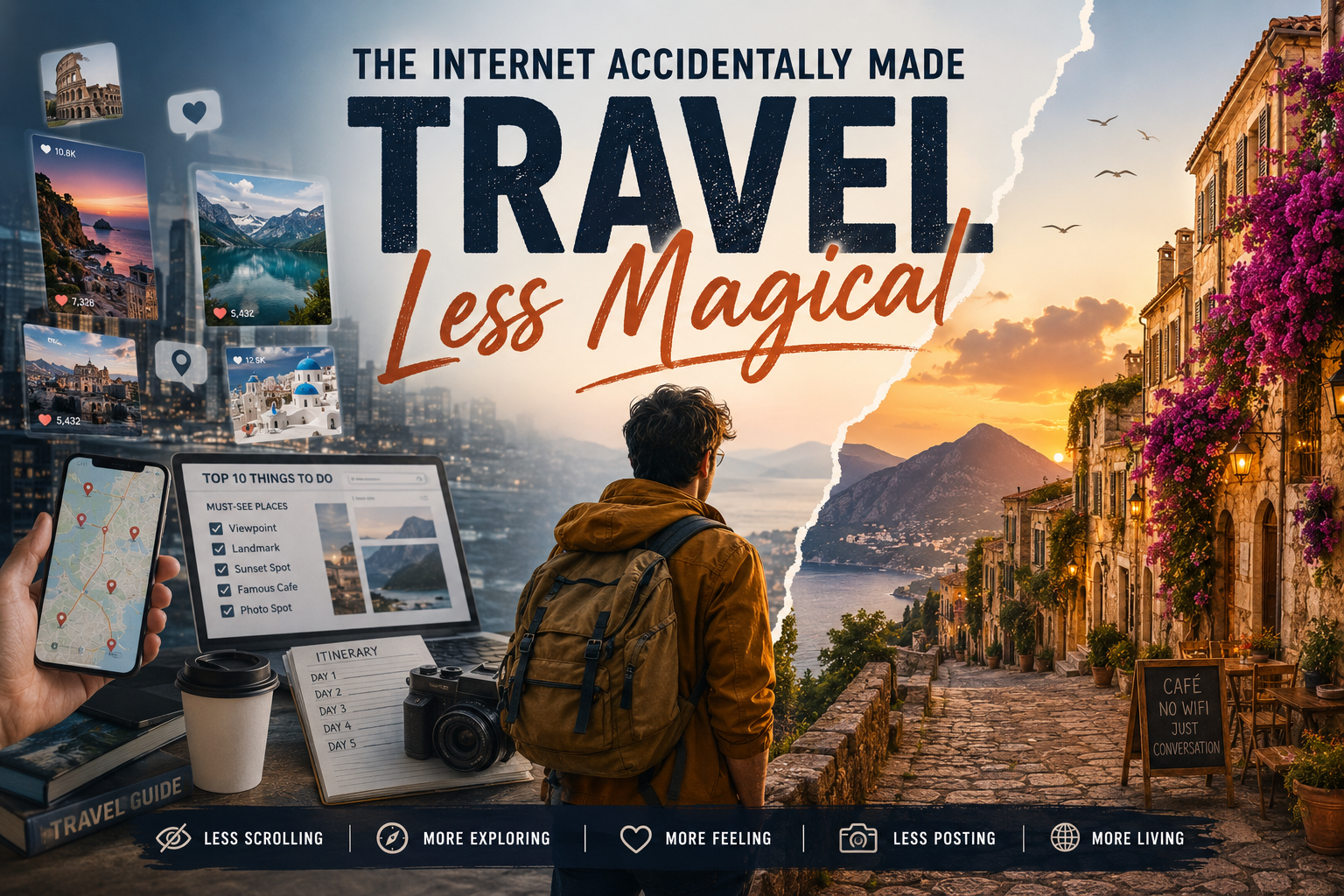
"The more connected we've become, the less surprised we've allowed ourselves to be."
Before the internet, travel was full of uncertainty.
You didn't know exactly what your hotel looked like.
You had no idea which café served the best coffee.
You couldn't watch hundreds of drone videos before arriving.
Every journey began with a question mark.
And somehow, that made it magical.
Today, we know almost everything before we leave home.
We can walk through hotel rooms using 360-degree tours.
We can explore entire cities on Street View.
We know where to stand for the perfect photo because millions of people have already stood there.
We've seen the sunset from Santorini before we ever smell the sea.
We've climbed Machu Picchu through someone else's GoPro.
We've watched cherry blossoms bloom in Kyoto thousands of times on Instagram.
Nothing feels truly unseen anymore.
Somewhere along the way, we traded discovery for certainty.
The Checklist Era
Modern travel often feels like completing a checklist.
Visit the famous viewpoint.
Take the same photo.
Eat at the restaurant with five thousand reviews.
Film a Reel.
Move on.
The destination becomes a backdrop rather than an experience.
People don't always ask,
"What surprised you?"
They ask,
"Did you go to that place from TikTok?"
Social media has given us access to the world, but it has also quietly shaped how we experience it.
We begin comparing our trip before it even starts.
We've Started Collecting Places Instead of Moments
Sometimes it feels as if we're collecting destinations like trophies.
Twenty countries.
Thirty countries.
Fifty countries.
The numbers grow.
But do the memories?
Years later, few people remember the exact viewpoint they visited.
They remember getting lost in a quiet neighborhood.
Sharing a meal with strangers.
Missing the last train.
Watching children play football in a local park.
Laughing because nobody spoke the same language.
The best travel memories are almost never the ones we planned.
Algorithms Are Becoming Our Tour Guides
Open any travel app.
You'll see lists.
Top ten attractions.
Best restaurants.
Must-see landmarks.
Hidden gems that somehow millions of people already know about.
Algorithms recommend places because they're popular.
Popularity creates more popularity.
Soon, everyone follows the same path.
Ironically, the internet helped us discover the world while encouraging us to experience it in exactly the same way.
The Lost Joy of Getting Lost
There was a time when getting lost was part of traveling.
You'd wander down a random street.
Find a tiny bookstore.
Hear music coming from an alley.
Sit in a café simply because it looked inviting.
Today, our phones gently pull us back toward efficiency.
Fastest route.
Highest-rated restaurant.
Nearest attraction.
Five-star reviews.
Navigation has become so good that spontaneity sometimes feels inefficient.
But perhaps getting lost was never a problem.
Perhaps it was the adventure.
Every Sunset Doesn't Need an Audience
Some moments become smaller the second we reach for our phones.
You've probably seen it.
A beautiful sunset.
Hundreds of people standing quietly.
Then...
Almost everyone lifts a phone.
For a few seconds, nobody is actually watching the sunset.
They're recording it.
The irony is heartbreaking.
The memory we wanted to preserve is the one we stopped experiencing.
Not every beautiful moment needs to become content.
Some moments deserve to exist only in memory.
AI Will Plan Better Trips Than We Ever Could
Here's the twist.
Artificial intelligence is about to become the world's greatest travel planner.
Tell it your budget.
Your interests.
Your travel dates.
Your dream experiences.
Within seconds, it'll create an itinerary that once took hours to build.
Objectively...
It will probably be better.
Smarter.
More efficient.
But here's the question.
If AI plans everything perfectly...
Where will the surprises come from?
Perhaps the future of travel isn't asking AI to make perfect plans.
Perhaps it's asking AI to leave room for imperfection.
Leave one afternoon completely empty.
Recommend one restaurant with no reviews.
Suggest one street that isn't famous.
Keep one surprise.
Because surprise is where stories begin.
Maybe Technology Isn't the Problem
The internet isn't the villain.
Neither is artificial intelligence.
In fact, they've made travel safer, cheaper, and more accessible than ever before.
The problem isn't technology.
It's our relationship with certainty.
We've become uncomfortable with not knowing.
We optimize everything.
The cheapest flight.
The highest-rated hotel.
The fastest route.
The perfect itinerary.
But the moments we remember most rarely happen because everything went according to plan.
Travel has always been about the unexpected.
Technology should help us reach those moments—not replace them.
The New Luxury
Luxury used to mean flying first class.
Five-star hotels.
Private beaches.
Today, the rarest luxury may be something else entirely.
Wonder.
Finding a place you didn't expect to love.
Talking to someone whose name you'll never know.
Watching a sunrise without thinking about posting it.
Getting lost in a city and not immediately opening a map.
Travel isn't valuable because we see famous places.
It's valuable because it changes us.
And change rarely happens inside an itinerary.
A Different Way to Use Technology
This is where I think travel is heading.
Not toward replacing curiosity with algorithms.
But enhancing curiosity.
Imagine telling an AI travel planner:
"Help me experience Tokyo like someone who has lived there for twenty years."
Or:
"Plan my trip, but leave one entire day unplanned."
Or even:
"Don't show me the most famous places. Show me somewhere I'll remember."
That's a future worth building.
Technology shouldn't remove discovery.
It should protect it.
Why We Built SearchSpot
At SearchSpot, we believe technology should make travel easier—not less meaningful.
Yes, finding flights should be simple.
Yes, comparing hotels should take minutes instead of hours.
Yes, planning should be smarter.
But the goal has never been to automate wonder.
The goal is to spend less time buried in browser tabs and more time standing somewhere that makes you forget to check your phone.
Because the best part of any journey isn't the booking.
It isn't the itinerary.
It isn't even the destination.
It's that quiet moment when reality turns out to be better than anything the internet could have shown you.
And no algorithm can fully predict that.
Maybe that's the magic we should never lose.
Turn this research into a real trip plan
SearchSpot helps you compare stays, routes, neighborhoods, and decision tradeoffs in one planning flow so you can move from reading to booking with more confidence.