
Instinct vs SearchSpot.ai for Trip Planning: We Gave Both the Same South Goa Request
Instinct handles travel like a personal assistant, while SearchSpot.ai helps travelers compare options and understand trade-offs. See how both responded to the same South Goa hotel request and a mid-search budget change.

TL;DR
- Instinct is a general AI assistant that handles travel alongside other personal tasks.
- SearchSpot.ai focuses on comparing travel options and explaining why each one fits.
- In our South Goa test, Instinct gave a concise shortlist while SearchSpot provided a structured comparison.
- When the budget changed, Instinct updated its shortlist while SearchSpot searched again and rebuilt the options.
- Choose Instinct for hands-off execution and SearchSpot for informed trip planning and curation.
Instinct and SearchSpot.ai solve different travel problems. Instinct is a general personal agent that can coordinate and complete tasks across a user’s life. SearchSpot is a specialized travel concierge designed to research options, compare trade-offs, and explain which choice best fits a traveler’s requirements.
Instinct is for the delegator: someone who wants a general personal assistant to handle travel alongside emails, calendars, rides, and other life administration.
SearchSpot is for the curator: someone who cares about shaping a particular trip, comparing trade-offs and finding experiences that match their preferences.
Comparison - Instinct vs SearchSpot
How Each of Them Approaches the Same Request Around Travel Planning
Instinct
Understand the user → collect personal context → determine the desired outcome → find a workable option → complete the task
SearchSpot
Understand the request → extract constraints → find current options → compare consistently → explain trade-offs → recommend the best fit
Let’s Give Both Tools the Identical Trip-Planning Test
We gave both tools the same trip-planning test. The prompt included objective requirements such as dates, budget, and availability, along with more subjective preferences such as atmosphere and travel style:
Find a three-night stay in South Goa for two adults from December 12–15, 2026. Keep the total room price below ₹30,000, including taxes. We want a quiet boutique property within walking distance of a less crowded beach and good cafés. Reliable Wi-Fi and free cancellation are important. Compare the three strongest options, explain the main compromise with each one and do not book anything.
How Did Instinct and SearchSpot Interpret the Request?
Both tools understood the essential requirements: three nights in South Goa, a ₹30,000 total budget, a quieter boutique stay, beach and café access, reliable Wi-Fi, free cancellation, and no booking without approval. The difference was in how they processed that brief.
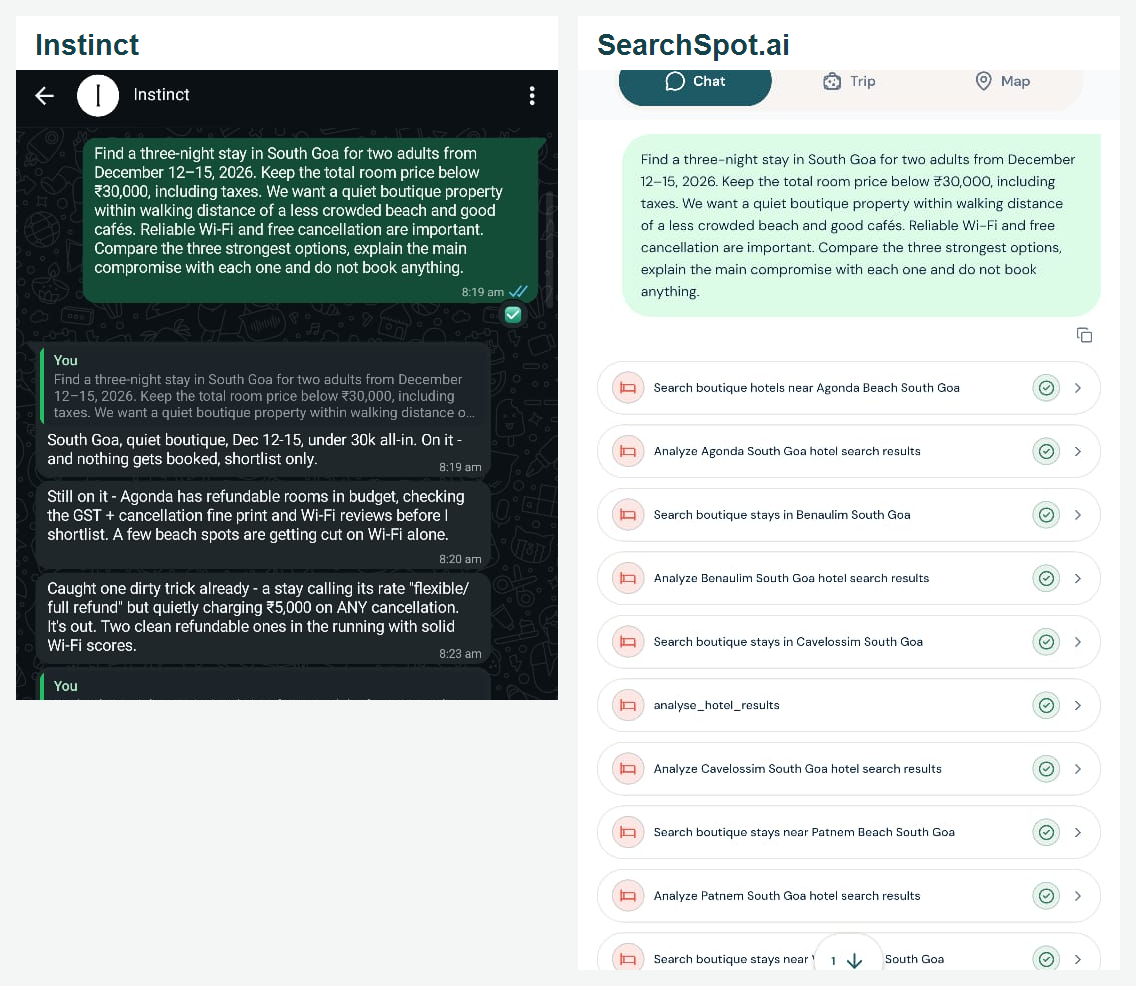
Instinct
- Condensed the request into a practical checklist: South Goa, quiet boutique property, fixed dates, ₹30,000 all-in, and shortlist only.
- Focused its search around Agonda and Patnem, checking GST, cancellation conditions, and Wi-Fi reviews before presenting any options.
- Shared progress as it worked, including when properties were removed because of weak Wi-Fi evidence or misleading cancellation terms.
SearchSpot
- Converted the request into travel-specific filters covering budget, location, beach walkability, nearby cafés, Wi-Fi, cancellation, and boutique character.
- Searched across several South Goa areas, including Agonda, Benaulim, Cavelossim, Patnem, Majorda and Betalbatim.
- Reported evaluating more than 650 properties before narrowing the results to stays that met the combined requirements.
How Did They Compare the Available Options?
Instinct produced a concise ranked shortlist. SearchSpot presented a more structured side-by-side comparison, helping the Traveler make a better decision.
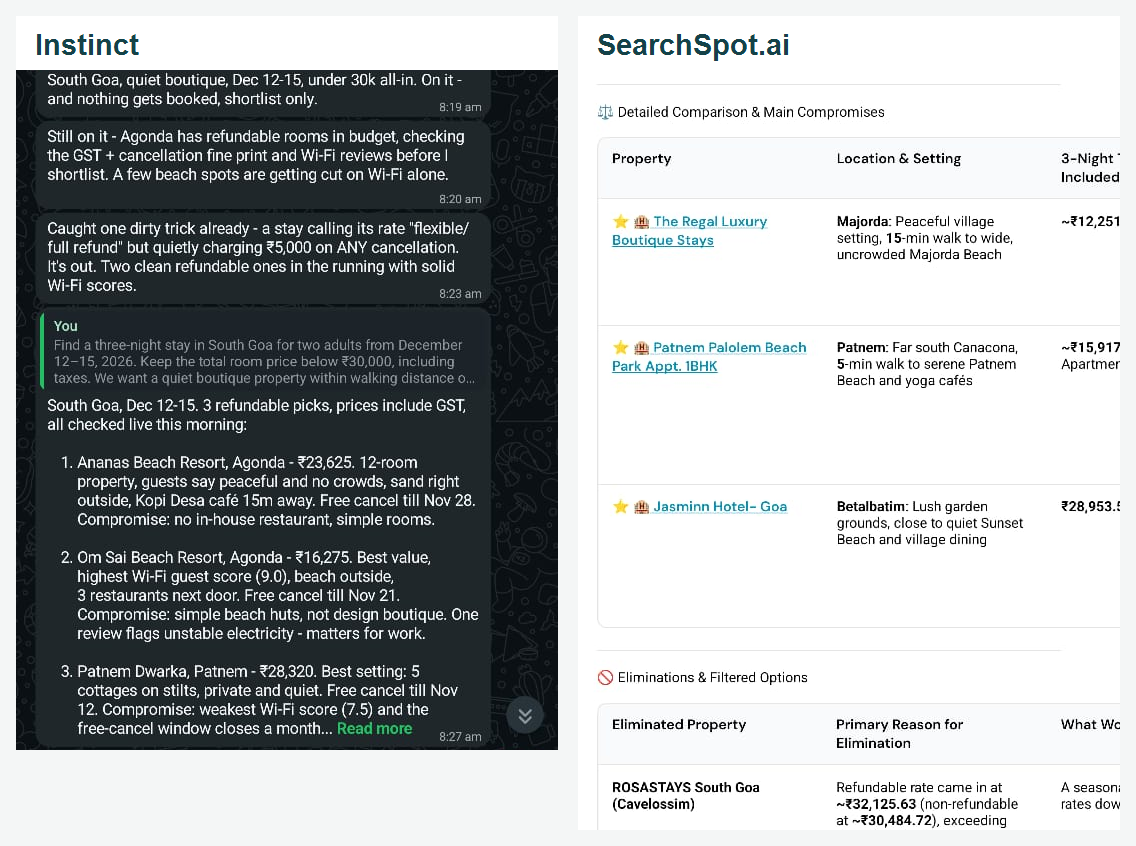
Instinct
- Recommended three properties with their total prices, cancellation deadlines, and the main drawback of each.
- Made a direct recommendation: Ananas Beach Resort was its overall pick, while Om Sai was the value option for someone prioritizing Wi-Fi over appearance.
- Kept the comparison conversational and compact, making it easy to move quickly toward a decision.
SearchSpot AI
- Compared its three recommendations using consistent categories such as location, setting, total price, cancellation, connectivity, and the main compromise.
- Made the differences between the options visible: one was economical, another offered better beach and café access, and another provided a more complete resort experience.
- Connected each option to a different travel priority instead of treating one property as the best choice for everyone.
How Did They Explain What Fit and What Did Not?
Both tools surfaced trade-offs, but SearchSpot made the elimination process more visible.
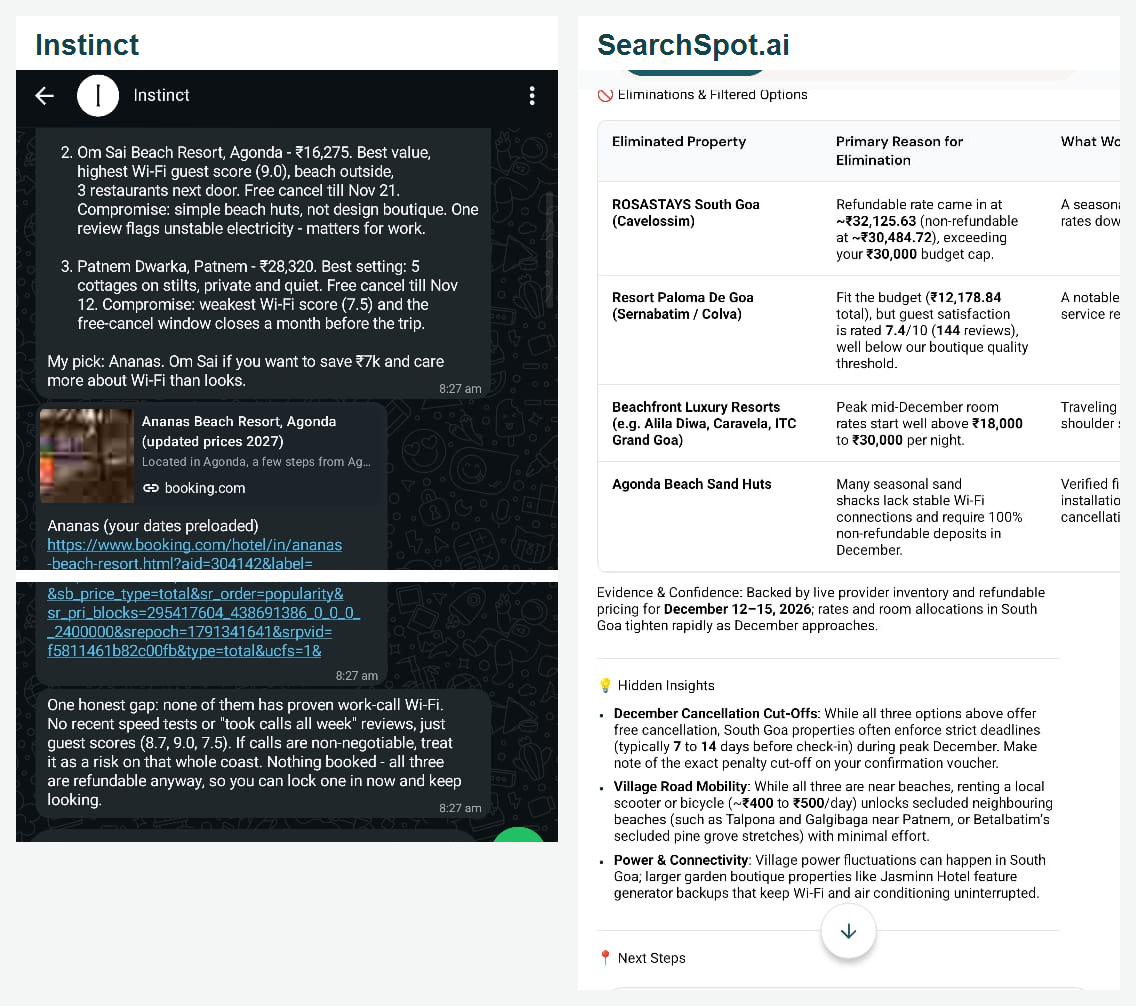
Instinct
- Removed a property after discovering that its “flexible” rate still charged ₹5,000 for any cancellation.
- Identified a specific compromise for every shortlisted property, including basic rooms, unreliable electricity, weak Wi-Fi scores, and early cancellation deadlines.
SearchSpot
- Displayed a separate list of rejected properties and the primary reason each one was removed.
- Excluded options for exceeding the budget, falling below its boutique-quality threshold, requiring non-refundable deposits, or offering unreliable Wi-Fi.
- Added practical context beyond the hotel listing, including cancellation cut-off dates, local scooter costs, and the risk of power fluctuations.
How Did They Respond When the Budget Changed?
Both tools correctly removed options above the revised ₹25,000 budget. Their responses reflected two different planning styles.
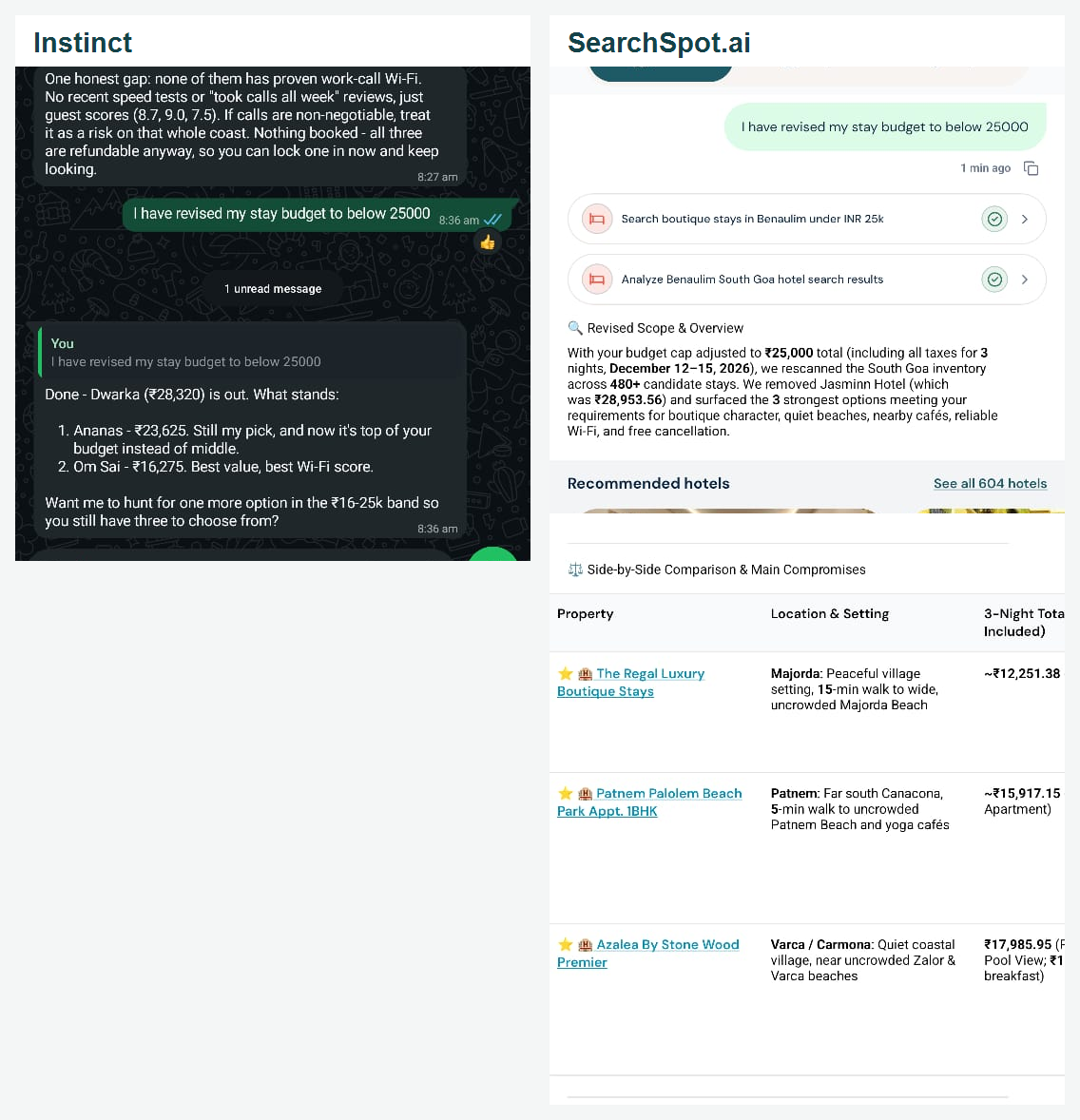
Instinct
- Immediately removed the stay options whose total exceeded the new limit.
- Retained Ananas Beach Resort and Om Sai Beach Resort without repeating the entire search.
- Preserved Ananas as its preferred option and asked whether it should find a third replacement within the new ₹16,000–₹25,000 range.
SearchSpot.ai
- Reported rescanning more than 480 candidate properties using the revised budget.
- Removed Jasminn Hotel and added Azalea by Stone Wood Premier as a new qualifying option.
- Rebuilt the three-property comparison and updated the elimination list, trade-offs, and recommendations around the new ceiling.
Where Instinct Remained Stronger
Instinct was stronger when the task needed a quick answer and less user involvement. It gave a clear recommendation, adjusted the shortlist immediately when the budget changed and offered to continue searching for a replacement.
Its broader value also lies beyond hotel comparison. Instinct can use personal context, coordinate calendars and messages, arrange airport rides, and follow up on related tasks. It is a better fit for someone who wants an assistant to manage the trip alongside the rest of their life.
Why SearchSpot Was Better for This Decision
SearchSpot was stronger at helping the traveler understand the choice. It compared every property using the same criteria, showed why some options were rejected, and made the compromise behind each recommendation clear.
When the budget changed, SearchSpot searched again and rebuilt the comparison instead of only removing the property that no longer qualified. This made it easier to see how the new budget changed the available choices.
Its advantage was not simply finding more hotels. It gave the traveler more confidence in why one option fit better than another.
Conclusion
Instinct is the better fit for someone who wants to say, “Handle my trip.”
SearchSpot is the better fit for someone who wants to say, “Help me shape the right trip.”
For travelers who care about the neighbourhood, atmosphere, and character of an experience as much as price, SearchSpot provides a clearer way to compare options and make the final choice.
Turn this research into a real trip plan
SearchSpot helps you compare stays, routes, neighborhoods, and decision tradeoffs in one planning flow so you can move from reading to booking with more confidence.