
Top AI-Powered Travel Booking Platforms in 2026: Compare the Best AI Travel Booking Tools
Discover the top AI-powered travel booking platforms in 2026 and compare SearchSpot, Google, Expedia, Hopper, Mindtrip, Layla, and Wanderlog.

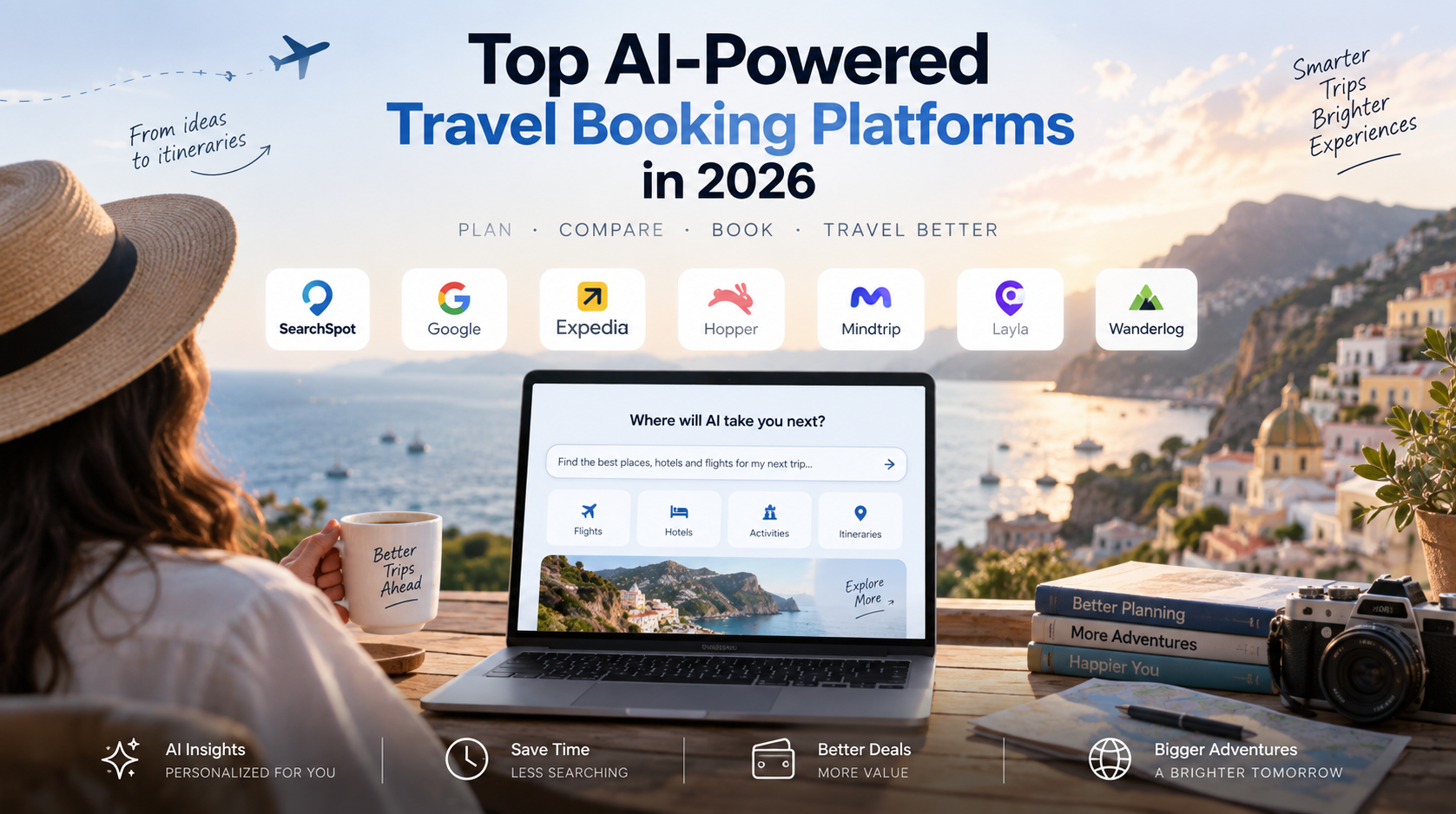
Planning and booking a trip in 2026 looks very different from the traditional travel search experience.
Instead of opening separate tabs for flights, hotels, restaurants, activities, maps, reviews, and travel blogs, travelers can increasingly use AI to research destinations, compare options, build itineraries, track prices, and even complete parts of the booking process.
The rise of AI-powered travel booking platforms is creating a new category between traditional online travel agencies, metasearch engines, AI trip planners, and digital travel agents.
But not every platform does the same thing.
Some are primarily designed to find and book flights and hotels. Others focus on AI itinerary generation. Some specialize in price prediction, while newer platforms focus on comparing complex travel decisions before you book.
In this guide, we'll look at some of the leading AI-powered travel booking and planning platforms in 2026, including SearchSpot, Google, Expedia, Hopper, Mindtrip, Layla, and Wanderlog, and explain what each platform is best suited for.
Quick answer: If you want traditional booking combined with increasingly sophisticated AI features, Google and Expedia are major options. Hopper is particularly focused on price prediction and deal timing. Mindtrip and Layla combine conversational AI with travel planning and booking capabilities. SearchSpot takes a different approach, focusing on AI-powered travel research, comparison, and decision-making before travelers commit to a booking.
What Are AI-Powered Travel Booking Platforms?
An AI-powered travel booking platform uses artificial intelligence to help travelers search, compare, plan, or book parts of a trip.
Traditional travel booking typically works like this:
Search → Filter → Compare → Book
AI-powered travel platforms are moving toward:
Describe what you want → AI understands your preferences → Discover options → Compare trade-offs → Plan → Book
For example, instead of searching separately for:
"Hotels in Goa"
you could ask:
"Find me a quiet beachfront hotel in South Goa under ₹6,000 per night, close to good cafes, suitable for a couple, with reliable Wi-Fi."
The goal is to make travel search more conversational and contextual.
Some platforms go further by connecting AI recommendations with live travel inventory, pricing, maps, reviews, or booking systems.
Google, for example, announced new AI Mode travel capabilities in August 2026, including flight-price tracking, points and miles information, and hotel booking within AI Mode. Google says its AI Mode travel experience can compare current flight information from more than 300 partner airlines and travel sites.
At the same time, Google reports that searches related to "AI travel assistant" and "AI concierge" have grown significantly in 2026, while searches for AI flight booking have also surged.
AI Travel Booking Platforms vs AI Trip Planners
These terms are often used interchangeably, but they aren't exactly the same.
AI trip planner
An AI trip planner primarily helps you create an itinerary.
It might recommend:
- Destinations
- Hotels
- Restaurants
- Attractions
- Routes
- Activities
- Daily schedules
AI travel booking platform
An AI travel booking platform goes further toward helping you actually purchase travel products such as:
- Flights
- Hotels
- Car rentals
- Activities
- Vacation packages
AI travel agent
An AI travel agent attempts to replicate more of the traditional travel-agent experience by understanding your requirements, building a trip, and potentially helping with the booking process.
The distinction matters because an attractive AI-generated itinerary doesn't necessarily mean the platform can actually book your flight or hotel.
Best AI-Powered Travel Booking Platforms in 2026
1. SearchSpot — AI-Powered Travel Research and Decision Making
SearchSpot.ai takes a slightly different approach from traditional online travel agencies.
Rather than positioning AI simply as a conversational layer over a booking database, SearchSpot focuses on helping travelers research, compare, and make decisions before booking.
That matters because travel decisions are rarely as simple as finding the cheapest hotel.
Consider a traveler searching for a hotel in Goa.
The cheapest option may not be the best option if it is:
- Far from the beach
- Difficult to reach without a car
- Located in a noisy area
- Far from restaurants
- Poorly suited to the traveler's itinerary
The real question isn't:
"What hotels are available?"
It is:
"Which hotel actually makes sense for my trip?"
SearchSpot is designed around this type of decision-making.
What SearchSpot can help travelers research
- Destinations
- Hotels and stays
- Neighborhoods
- Restaurants
- Routes
- Activities
- Travel budgets
- Transportation options
- Trip itineraries
- Trade-offs between different options
The platform's broader philosophy is that AI travel should not simply generate more options. It should help travelers understand which options fit their specific requirements.
For a deeper explanation of this approach, see our guide to the best AI trip planners in 2026.
Best for
Travelers who want to research and compare options before making a booking decision.
SearchSpot's biggest difference
Many travel platforms begin with booking inventory.
SearchSpot begins with the traveler's question.
That makes it particularly useful for complicated searches involving multiple constraints.
For example:
"I'm traveling to Japan for 9 days in October. I like photography, hiking, anime and food. My budget is £2,000 and I don't want to spend more than one day in museums."
Instead of simply generating a generic itinerary, the objective is to understand the constraints behind the trip.
You can also read our AI Travel Planner for India guide to see how AI can be used for more complex India travel planning.
2. Google — AI Travel Search and Booking
Google Travel has become one of the most significant players in AI-assisted travel discovery because Google already has access to Flights, Hotels, Maps, Search, and other travel-related information.
In August 2026, Google announced new travel capabilities inside AI Mode.
Travelers can now use AI Mode to track flight prices and explore flight and hotel options conversationally. Google also introduced hotel booking within AI Mode, allowing users to discover hotels, compare information, and proceed through the booking process.
Google's Gemini ecosystem is also increasingly connected to travel planning.
Google says Gemini can use information from Google Maps, Flights, and Hotels to create personalized travel itineraries. It can also use connected information from services such as Gmail, Photos, and YouTube when users choose to connect them.
Best for
Travelers who already use Google's ecosystem and want AI-assisted discovery combined with established flight, hotel, and map infrastructure.
Key strengths
- Google Flights
- Google Hotels
- Google Maps
- AI Mode
- Flight-price tracking
- Points and miles information
- Hotel discovery
- Personalized itinerary planning
Potential limitation
Google's strength is the breadth of its ecosystem. Travelers who want highly specialized decision-making around a complex trip may still want a dedicated AI travel research platform.
3. Expedia — AI-Assisted Travel Booking
Expedia is one of the largest traditional travel booking companies incorporating AI into its travel experience.
Expedia's travel ecosystem covers flights, hotels, vacation rentals, activities, cars, and packages.
The company also offers an AI chat assistant designed to help travelers discover and plan trips.
Expedia describes its AI capabilities as helping personalize recommendations based on traveler preferences and previous behavior.
This makes Expedia an interesting example of how traditional online travel agencies are adapting to generative AI.
Instead of replacing the booking engine, AI becomes an additional interface for discovering and selecting travel products.
Best for
Travelers who want AI assistance while staying within a conventional booking ecosystem.
Key strengths
- Flights
- Hotels
- Vacation rentals
- Activities
- Car rentals
- Packages
- AI-assisted recommendations
Potential limitation
The experience is fundamentally connected to a large booking marketplace, so it is more booking-oriented than research-first.
4. Hopper — AI-Powered Price Prediction
Hopper takes a different approach to AI-powered travel.
Rather than focusing primarily on generating itineraries, Hopper has built much of its travel experience around price prediction and timing decisions.
Its technology analyzes travel prices and provides recommendations about whether travelers should book now or wait.
Hopper's AI-powered booking technology is also being deployed through partner travel experiences. For example, a 2026 CommBank travel-booking implementation powered by Hopper describes an AI-powered price prediction tool that tracks flight prices and predicts when it may be an appropriate time to book.
Best for
Travelers who already know where they want to go and primarily care about price timing.
Key strengths
- Flight-price prediction
- Price tracking
- Deal discovery
- Hotel pricing
- Car rentals
- Mobile-first experience
Potential limitation
Price optimization is only one part of trip planning. It doesn't necessarily answer broader questions such as which neighborhood to stay in or whether a destination fits your travel style.
5. Mindtrip — AI Travel Planning With Booking
Mindtrip combines conversational AI with visual travel discovery.
The platform is designed to help travelers discover destinations, build itineraries, explore places through maps and images, and organize travel plans.
In 2026, Mindtrip also expanded into in-chat flight booking through Sabre and PayPal, bringing the platform closer to the traditional definition of an AI travel booking assistant.
Mindtrip is particularly interesting because it sits between:
AI inspiration + itinerary planning + booking
rather than focusing exclusively on one part of the journey.
Best for
Travelers who enjoy visual exploration and want to move from inspiration toward a bookable itinerary.
Key strengths
- Conversational planning
- Visual discovery
- Maps
- Itineraries
- Travel recommendations
- Collaboration
- Flight booking
Potential limitation
Travelers looking for highly detailed comparison and decision support may still want additional research before committing to a booking.
6. Layla — AI Travel Agent and Booking Assistant
Layla describes itself as an AI travel planner and travel agent.
The platform can create personalized itineraries involving flights, hotels, activities, maps, and pricing.
One interesting aspect of Layla's model is its combination of AI planning with human travel expertise. Layla says its human agents can assist with booking after the AI has created the itinerary.
Layla is therefore closer to the concept of an AI-assisted travel agent than a simple itinerary generator.
Best for
Travelers who want conversational trip planning combined with a path toward actual booking and human assistance.
Key strengths
- AI itinerary generation
- Flight research
- Hotel recommendations
- Activities
- Maps
- Live pricing
- Human travel assistance
Potential limitation
Travelers should still verify prices, cancellation conditions, availability, and other booking details before paying.
7. Wanderlog — AI-Assisted Trip Organization
Wanderlog approaches travel from the organization side.
Rather than being solely an AI booking engine, Wanderlog is designed to help travelers organize existing trip information.
Its features include:
- Itinerary planning
- Maps
- Reservations
- Budget management
- Route optimization
- Collaboration
- Travel research
This makes it especially useful for travelers who have already decided where they are going and need a central place to organize the trip.
Best for
Groups and travelers who need to organize an existing trip.
Key strengths
- Trip organization
- Collaborative planning
- Maps
- Reservations
- Budgeting
- Itinerary management
Potential limitation
It is more focused on organizing a trip than replacing the entire travel research and booking process.
AI Travel Booking Platforms Comparison
| Platform | AI Planning | Flight Booking | Hotel Booking | Price Intelligence | Itinerary | Decision Support | Best For |
|---|---|---|---|---|---|---|---|
| SearchSpot | Yes | Research | Research | Emerging | Yes | Strong focus | Travel research & decisions |
| Yes | Yes | Yes | Yes | Yes | Moderate | AI-assisted search & booking | |
| Expedia | Yes | Yes | Yes | Yes | Yes | Moderate | Full-service booking |
| Hopper | Limited | Yes | Yes | Strong | Limited | Price-focused | Finding the right time to book |
| Mindtrip | Yes | Yes | Yes | Yes | Strong | Moderate | Visual discovery & planning |
| Layla | Yes | Yes | Yes | Yes | Strong | Moderate | AI travel-agent experience |
| Wanderlog | Yes | Via integrations | Yes | Limited | Strong | Moderate | Trip organization |
The important point is that these platforms aren't direct substitutes for one another.
A traveler looking for the cheapest flight may have very different requirements from someone trying to decide between three destinations or two hotel neighborhoods.
What Should You Look For in an AI Travel Booking Platform?
Before choosing an AI-powered travel platform, consider these seven factors.
1. Does It Use Real-Time Travel Data?
Travel information changes constantly.
Flight prices change.
Hotel availability changes.
Restaurants close.
Attractions change opening hours.
Visa requirements can change.
An AI-generated answer is only as useful as the underlying information.
For anything involving prices or availability, verify the final information directly with the booking provider.
2. Can It Understand Natural-Language Requests?
A good AI travel platform should understand requests such as:
"Find a romantic hotel in North Goa under ₹5,000 that's close to restaurants but away from the nightlife."
That's much more useful than forcing travelers to manually select dozens of filters.
3. Can It Compare Options?
This is one of the biggest differences between an AI assistant and a traditional search engine.
You don't always need 50 options.
You often need three good options and an explanation of the trade-offs.
For example:
| Option | Price | Location | Best For | Trade-off |
|---|---|---|---|---|
| Hotel A | ₹4,000 | Central | Restaurants | Smaller rooms |
| Hotel B | ₹5,000 | Beachfront | Couples | Further from city |
| Hotel C | ₹3,500 | Quiet area | Budget | Requires transport |
The ability to understand these trade-offs is becoming increasingly important in AI travel.
4. Can It Handle Multiple Constraints?
Real travelers rarely have only one requirement.
A typical request might include:
- Budget
- Dates
- Number of travelers
- Food preferences
- Hotel preferences
- Accessibility
- Distance
- Transportation
- Activities
- Weather
- Travel pace
The more constraints a platform can understand simultaneously, the more useful it becomes for complex trips.
This is one of the areas where AI-powered travel research can go beyond traditional keyword search.
5. Does It Explain Why It Made a Recommendation?
An AI recommendation should ideally have a reason behind it.
Instead of:
"Stay here."
You want:
"This hotel fits your ₹5,000 budget, is closer to the cafes you selected, and avoids the nightlife-heavy area you said you wanted to avoid."
That creates transparency and makes it easier for travelers to make the final decision themselves.
6. Can You Actually Book?
This is where the distinction between an AI planner and AI booking platform becomes important.
Some platforms generate recommendations but send you elsewhere to book.
Others integrate booking directly into the experience.
Before using a platform, check whether it supports:
- Direct booking
- Partner booking
- Price tracking
- Cancellation management
- Reservation management
- Customer support
7. Can You Verify the Recommendation?
AI should make travel planning faster, but travelers should still verify important information.
Before paying, check:
- Final price
- Taxes and fees
- Cancellation policy
- Hotel address
- Room type
- Flight times
- Baggage allowance
- Visa requirements
- Passport requirements
- Local restrictions
AI can accelerate research, but the traveler should remain in control of the final booking.
Why AI Travel Booking Is Changing in 2026
The biggest change isn't simply that travel websites are adding chatbots.
The bigger shift is that travel search is becoming conversational.
Traditional search:
"Hotels in Tokyo"
AI travel search:
"I'm visiting Tokyo for five days in October. I want to spend most of my time eating, exploring anime culture and taking photographs. I don't want to change hotels and I'd prefer to stay somewhere with good train access."
The second query contains far more information about the actual decision.
This allows AI systems to reason about:
- Intent
- Preferences
- Constraints
- Budget
- Geography
- Timing
- Trade-offs
Google's 2026 travel updates demonstrate this transition particularly clearly, with AI Mode combining conversational search with live travel information, price tracking, and hotel booking.
AI Travel Booking Isn't the Same as AI Travel Planning
This distinction will become increasingly important.
Imagine three travelers.
Traveler 1: "I know where I'm going."
They need:
Flight + hotel + price tracking + booking
A platform like Google, Expedia, or Hopper may be particularly relevant.
Traveler 2: "I know roughly what I want, but I need help planning."
They need:
Destination research + itinerary + hotels + activities
Mindtrip or Layla may fit this type of workflow.
Traveler 3: "I don't know which option actually makes sense."
They need:
Research + comparison + constraints + trade-offs + decision support
This is where an AI travel research platform such as SearchSpot can play a different role.
The future of travel AI isn't necessarily about creating one universal winner.
It is about connecting the different stages of the travel journey.
How SearchSpot Fits Into the AI Travel Ecosystem
SearchSpot is built around a simple problem:
Travelers have too many choices and not enough decision confidence.
Booking platforms are excellent at showing inventory.
Travel blogs are excellent at providing inspiration.
Maps are excellent at showing geography.
Review platforms are excellent at showing opinions.
But travelers still have to connect all those pieces.
That's where an AI travel decision engine can be useful.
For example:
"Should I stay in Baga, Anjuna or Candolim if I'm traveling as a couple, want good cafes, don't want a party-heavy area, and have a ₹6,000 hotel budget?"
That's not simply a booking query.
It's a decision problem.
SearchSpot's approach is to help travelers research those trade-offs before they commit.
You can explore this approach further in our AI Travel Assistants comparison, where we look at how SearchSpot, Layla, Mindtrip, and Wanderlog approach travel assistance differently.
You can also read our Best AI-Powered Travel Search Platforms in 2026 guide for a broader look at AI-native travel discovery.
The Future of AI Travel Booking
The travel booking process is likely to become increasingly conversational.
Instead of:
Google → Blog → Maps → Booking.com → Reviews → Spreadsheet → Hotel
the future may look more like:
AI Travel Assistant → Research → Compare → Decide → Book
The AI becomes the interface connecting different parts of the travel journey.
That doesn't mean travelers will stop using booking websites.
Instead, booking websites may increasingly become the infrastructure underneath AI-powered travel experiences.
The user experience moves toward conversation.
The booking infrastructure remains underneath.
Frequently Asked Questions
What is an AI-powered travel booking platform?
An AI-powered travel booking platform uses artificial intelligence to help travelers discover, compare, plan, price, or book travel products such as flights, hotels, activities, and transportation.
What is the best AI travel booking platform in 2026?
There isn't one platform that is best for every type of traveler.
Google and Expedia combine AI with large booking ecosystems. Hopper focuses heavily on price prediction. Mindtrip and Layla combine conversational planning with booking-related functionality. SearchSpot focuses more heavily on AI-powered travel research, comparison, and decision-making.
Can AI book flights?
Yes. Some AI-powered travel experiences now support flight booking or connect travelers to booking partners. Google introduced hotel booking through AI Mode in 2026, while Mindtrip expanded into in-chat flight booking during 2026.
Can AI find cheaper flights?
Some platforms use price tracking and predictive technologies to help travelers decide when to book. Hopper is particularly focused on this use case, while Google also offers flight-price tracking through its travel ecosystem.
Are AI travel planners reliable?
They can be useful, but important details should be verified before booking. Prices, availability, schedules, opening hours, cancellation policies, and travel requirements can change.
What is the difference between an AI travel planner and an AI travel booking platform?
An AI travel planner primarily helps create and organize a trip. An AI travel booking platform goes further by connecting travelers with booking inventory or enabling transactions for flights, hotels, activities, or other travel products.
Final Thoughts
AI-powered travel booking is moving beyond simple chatbots.
In 2026, the major travel platforms are increasingly combining conversational AI with real-time search, price tracking, hotel discovery, itinerary generation, and booking.
But travelers don't all need the same thing.
If you already know your destination and want to book efficiently, a platform such as Google, Expedia, or Hopper may be useful.
If you want visual discovery and conversational itinerary planning, Mindtrip is worth exploring.
If you want an AI-assisted travel-agent experience, Layla is another option.
If your biggest problem is organizing an existing trip, Wanderlog can help.
And if your problem is:
"I have too many options. Which one actually makes sense for my trip?"
that's where SearchSpot is designed to help.
The future of travel AI isn't simply about booking faster.
It's about making better travel decisions before you book.
Ready to plan your next trip? Explore SearchSpot and start researching your options with AI.
 Hiten Sethiya
 Hiten Sethiya
Turn this research into a real trip plan
SearchSpot helps you compare stays, routes, neighborhoods, and decision tradeoffs in one planning flow so you can move from reading to booking with more confidence.