
How SearchSpot AI Plans a 2-Week Japan Trip — Step by Step
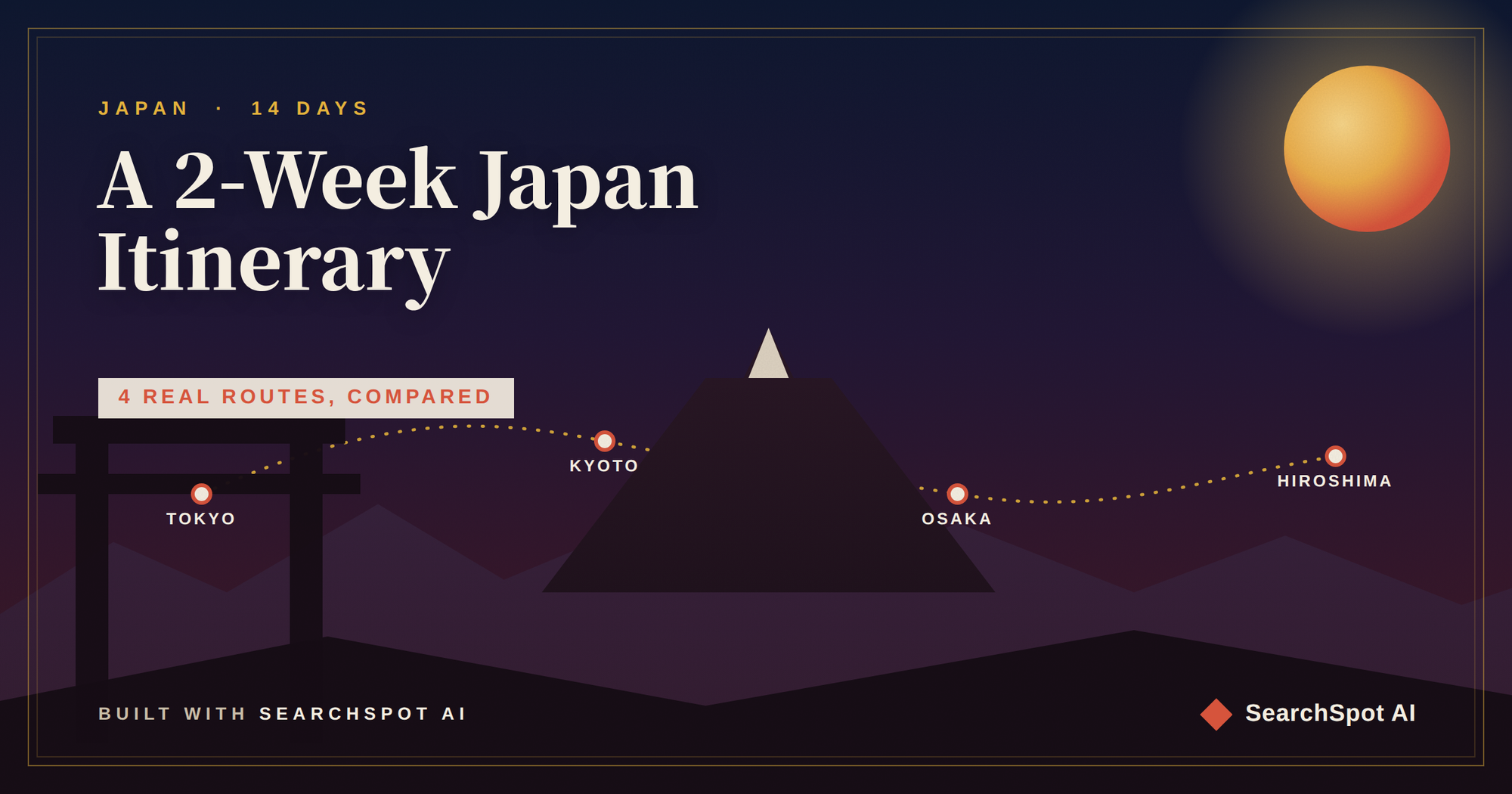
Most Japan trip planning means dozens of open tabs and a spreadsheet. Here's a step-by-step look at planning the same 2-week Tokyo-Kyoto-Osaka-Hiroshima trip in one AI conversation.

Last updated: August 5, 2026
Planning a two-week Japan trip usually means dozens of open tabs — flight searches, hotel comparisons, blog posts about which cities to combine, and a spreadsheet trying to hold it all together. Here's what it looks like to plan the same trip in a single conversation with SearchSpot AI, from the first prompt to a full day-by-day route with reasoning.
Step 1: Start with a simple prompt
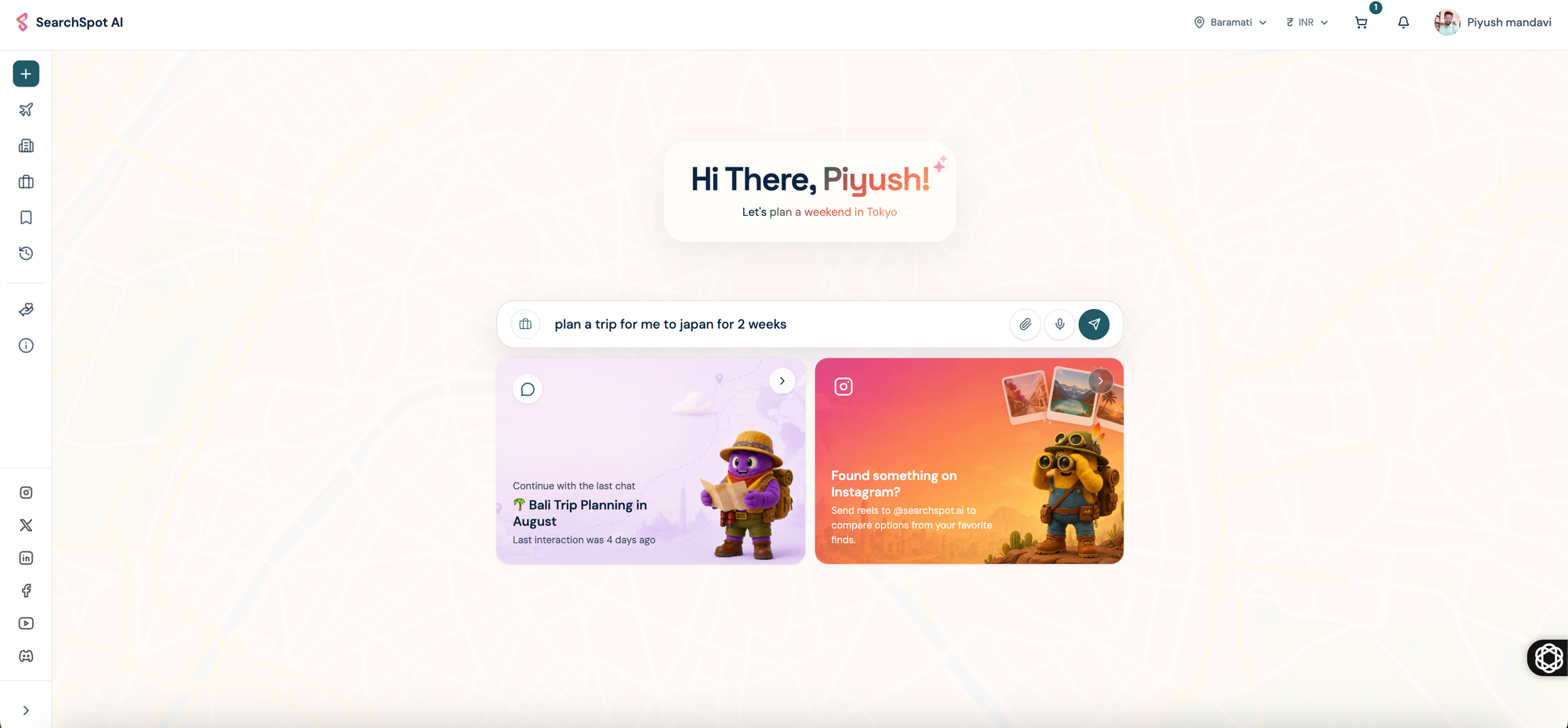
It starts on the home screen with a single message: "plan a trip for me to japan for 2 weeks." No forms to fill out first — just describe the trip the way you'd tell a friend.
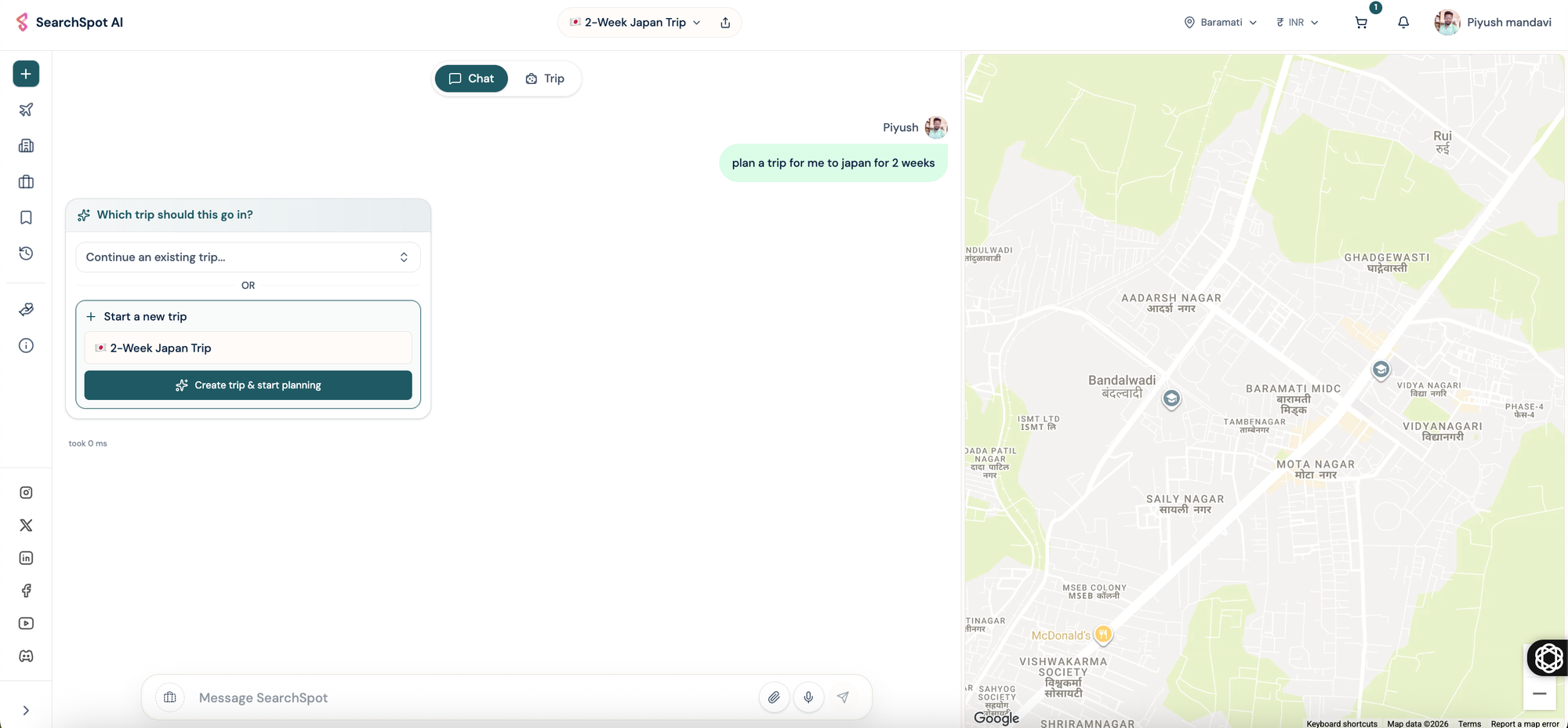
Step 2: The trip gets its own workspace
SearchSpot AI creates a dedicated trip — "2-Week Japan Trip" — so every message, question, and saved detail from here on stays organized in one place instead of scattered across a chat history.
Step 3: Four real route options, not one generic answer
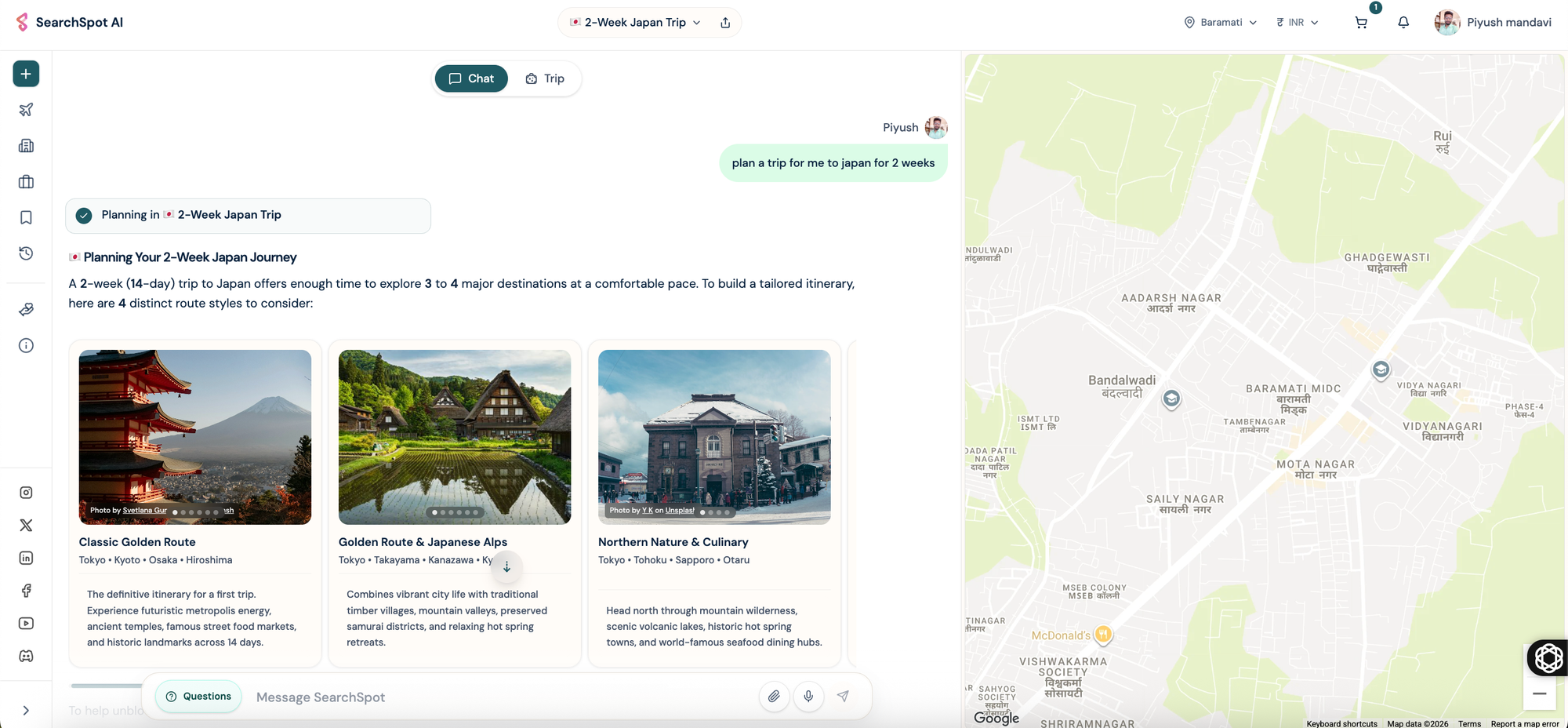
Rather than guessing at a single itinerary, SearchSpot AI proposes four distinct route styles for a 14-day trip:
- Classic Golden Route — Tokyo, Kyoto, Osaka, Hiroshima
- Golden Route & Japanese Alps — Tokyo, Takayama, Kanazawa, Kyoto
- Northern Nature & Culinary — Tokyo, Tohoku, Sapporo, Otaru
- Southern Kyushu & Kansai — Fukuoka, Kumamoto, Hiroshima, Kyoto
Each comes with a short description of what it prioritizes, so the choice is about travel style, not city trivia.
Step 4: A few quick questions replace a long form
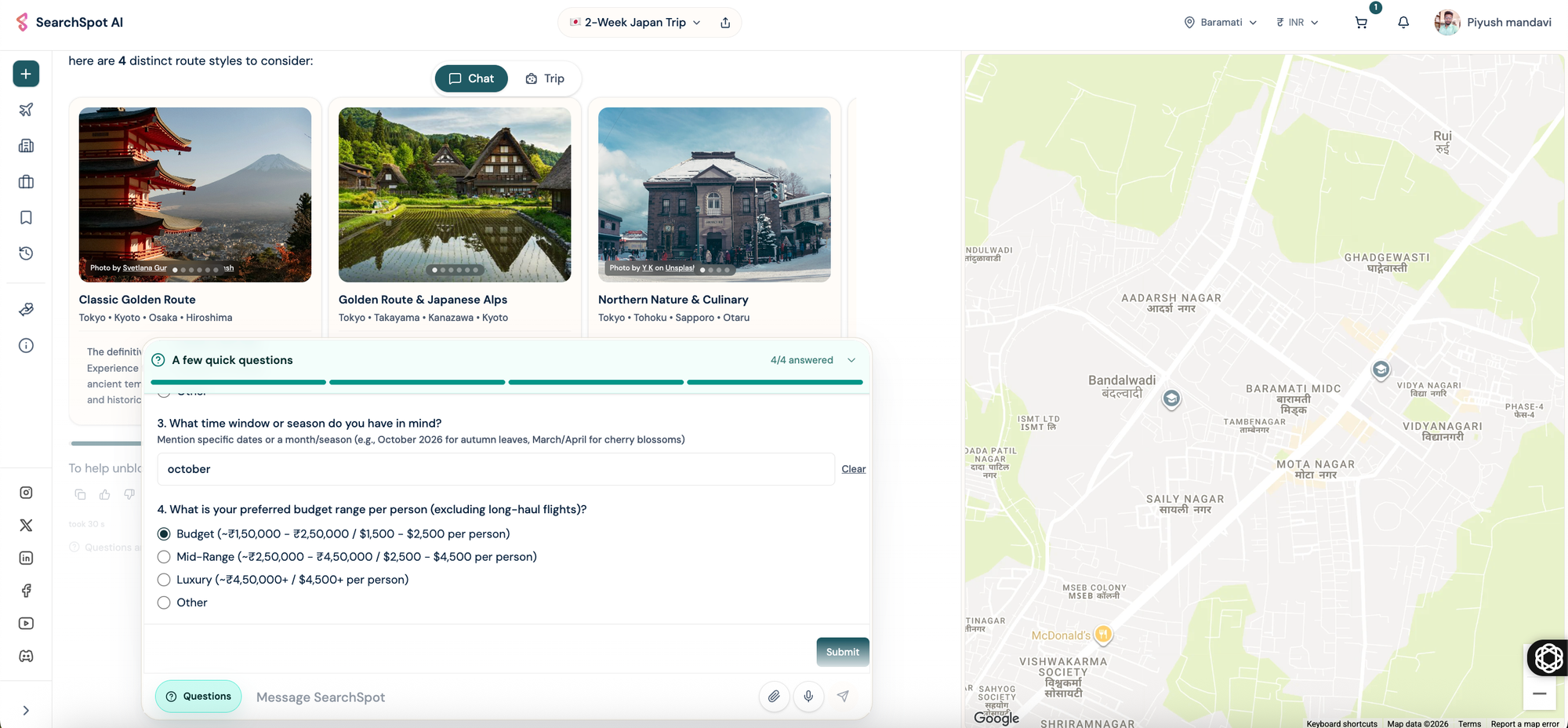
Instead of a 20-field questionnaire, SearchSpot AI asks four short questions: preferred route orientation, who's traveling, timing or season, and budget range. Each one narrows the plan down further.Season and budget come next — with real currency ranges (₹ and $) shown side by side, so there's no back-and-forth converting numbers later.As each question gets answered, a progress bar fills in — by question four, the trip profile is fully defined: solo traveler, October, Classic Golden Route, ₹1,50,000–₹2,50,000 budget.
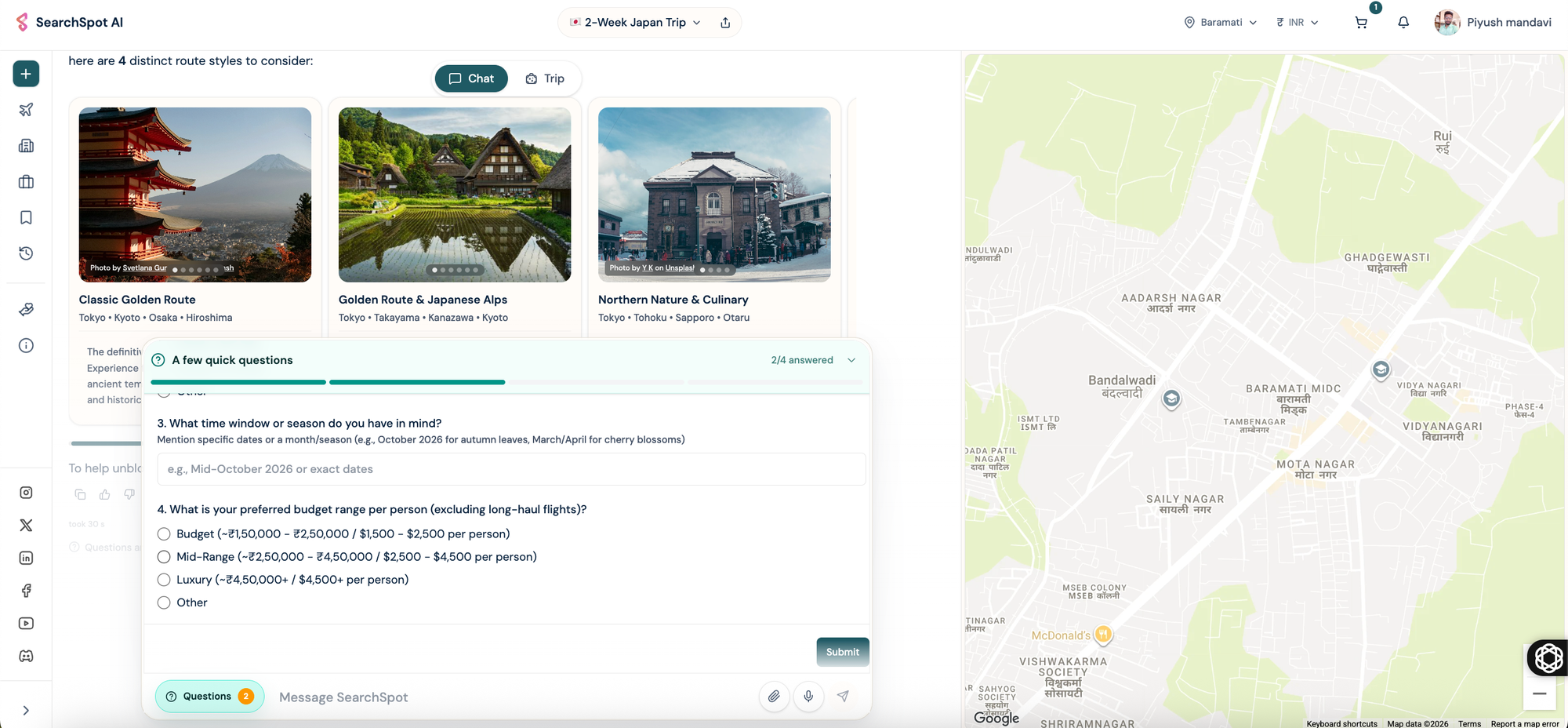
Step 5: Three night-by-night distributions, each with a reason
With the profile set, SearchSpot AI doesn't just hand back one itinerary — it shows three ways to split 14 nights across Tokyo, Kyoto, Osaka, and Hiroshima, each suited to a different pace:
| Distribution | Split | Best for |
|---|---|---|
| Balanced Capital & Culture | 6N Tokyo · 4N Kyoto · 2N Osaka · 1N Hiroshima | First-timers wanting full days in each city |
| Kansai & History Focus | 4N Tokyo · 5N Kyoto · 3N Osaka · 2N Hiroshima | Slower pace, more time in Kyoto and Hiroshima |
| Urban Metropolis Heavy | 7N Tokyo · 3N Kyoto · 3N Osaka · 1N Hiroshima | Big-city energy, nightlife, shopping |
The map on the right places every city geographically as the plan builds, so the route makes visual sense before a single hotel is booked.
Step 6: What got ruled out — and why
This is the part most trip-planning content skips entirely: SearchSpot AI shows the options it considered and rejected, with the actual reasoning.
- 5+ City Hop (adding Takayama/Kanazawa) — ruled out, because changing hotels five or more times in 14 days as a solo traveler on a budget adds unnecessary transit costs and fatigue.
- Hiroshima as a day trip (no overnight) — not recommended, because it leaves too little time for Miyajima Island, where staying overnight avoids the afternoon tourist crowds.
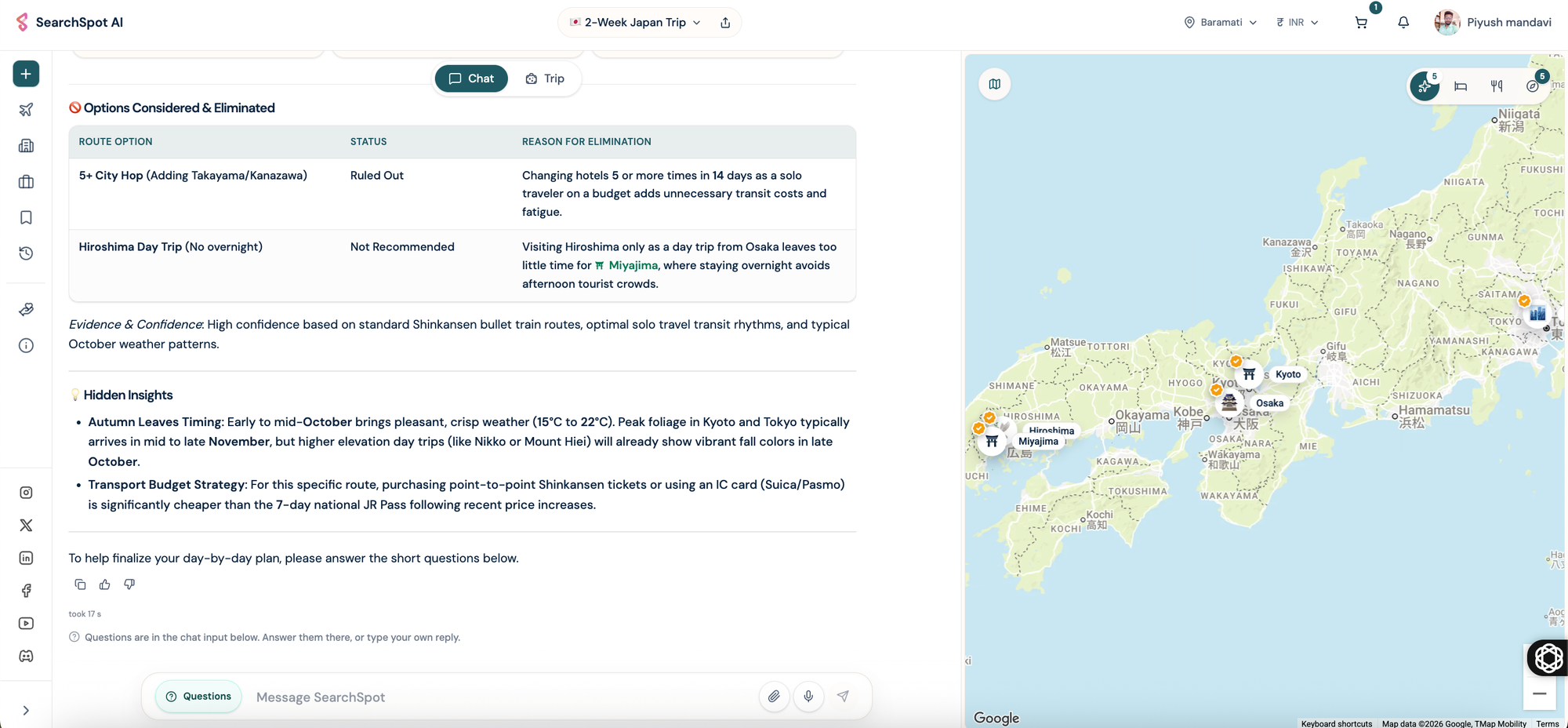
Below that, two "hidden insights" surface details a traveler might not think to search for on their own: early-October foliage timing at higher-elevation day trips like Nikko, and why point-to-point Shinkansen tickets currently beat a 7-day JR Pass on this specific route.## Why this matters more than a static itinerary
A blog post or listicle gives you one person's opinion of a good Japan route, written once and never updated. SearchSpot AI gives you the reasoning behind several options, built around your actual dates, budget, and travel style — and it stays editable as your plans change.
Ready to build your own version? Start a conversation with SearchSpot AI and describe your trip the way you would to a friend — the routes, the questions, and the reasoning happen from there.
Turn this research into a real trip plan
SearchSpot helps you compare stays, routes, neighborhoods, and decision tradeoffs in one planning flow so you can move from reading to booking with more confidence.