
🇯🇵 Family Trip to Japan — Complete Travel Plan
Plan a relaxed 20-day Japan family trip with elderly parents, covering Tokyo, Hakone, Kyoto, Nara and Osaka with smart pacing, rest days, budget planning, and practical travel tips.

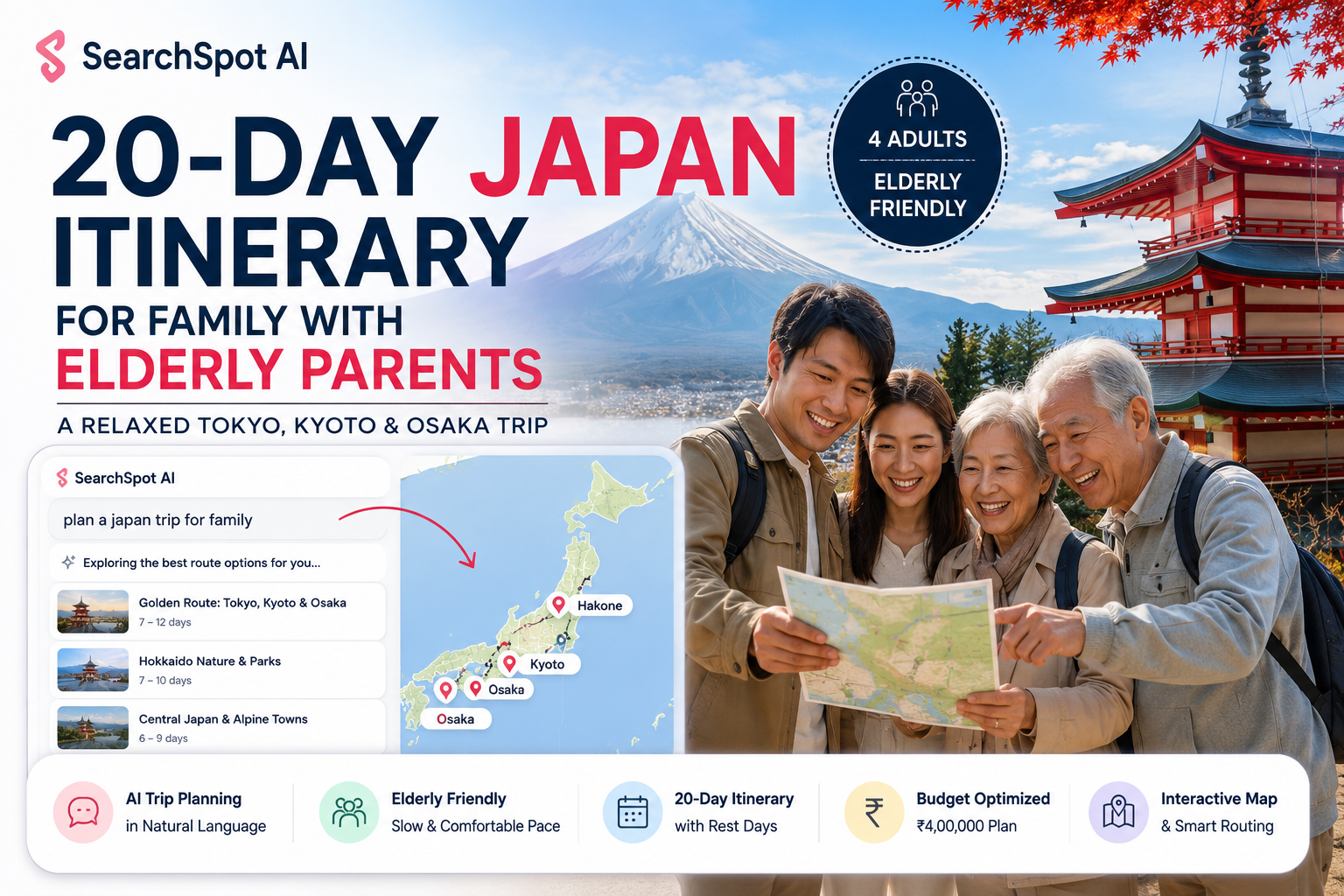
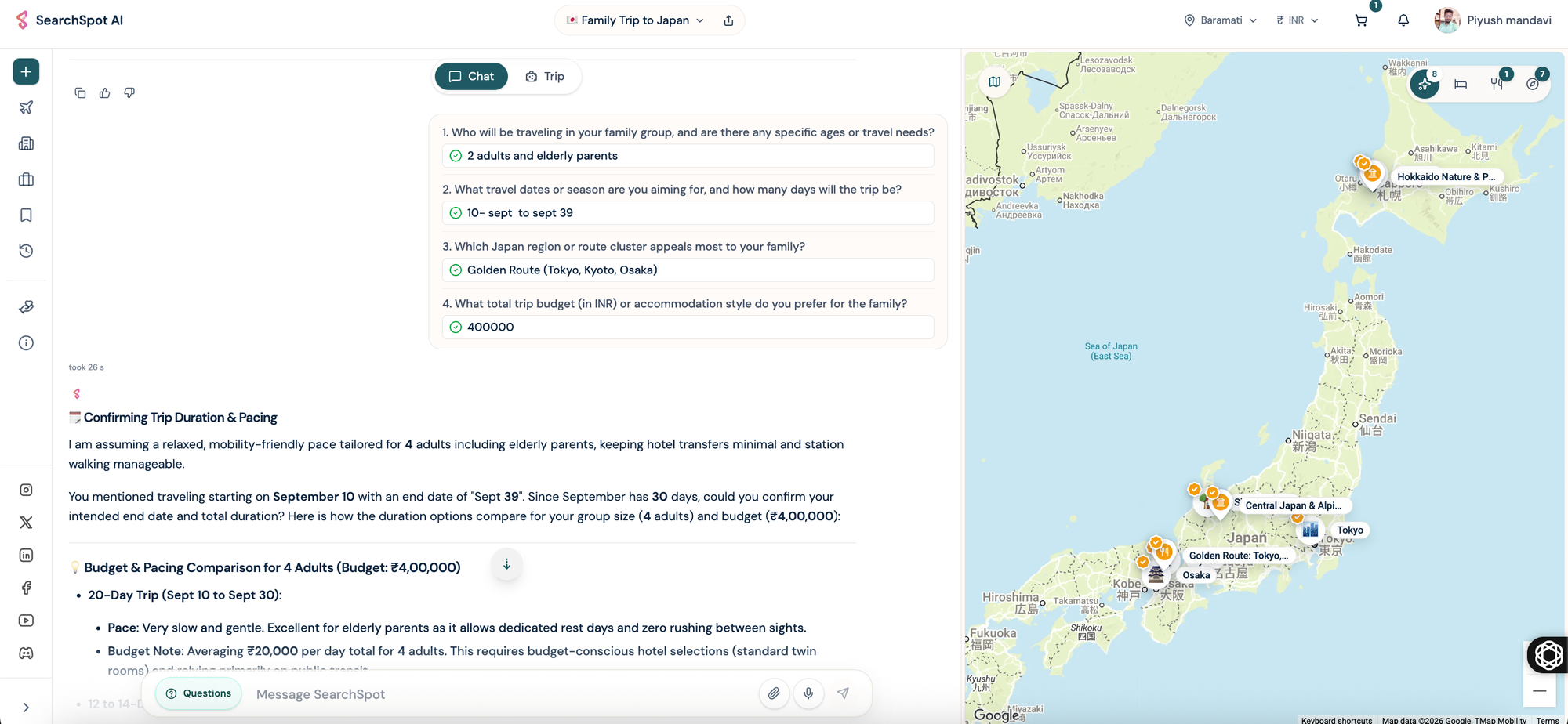
Planning parameters: 4 adults (2 adults + 2 elderly parents) · 20 days · ₹4,00,000 budget · Golden Route · 4-star hotels · mobility-friendly pace
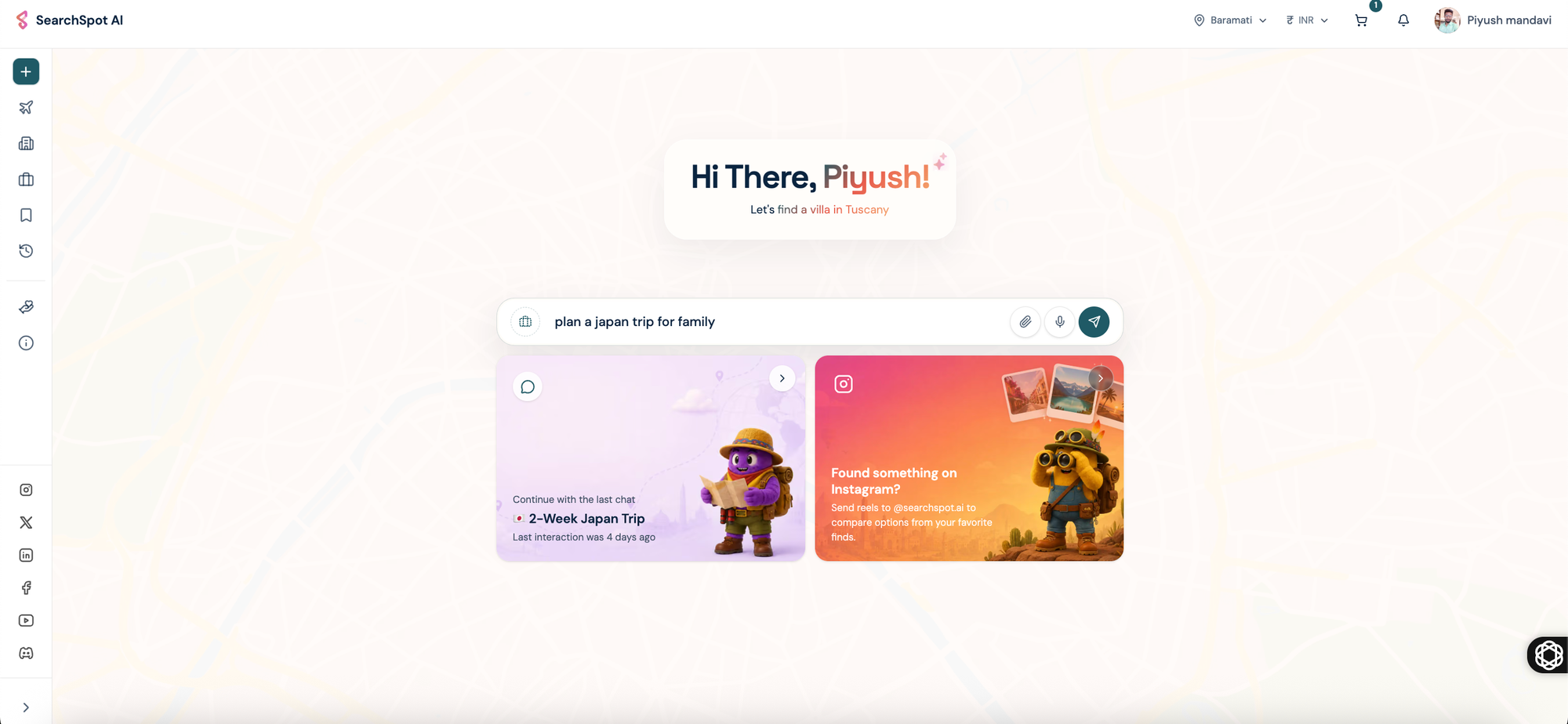
Planning a Japan trip for four adults becomes more complicated when two travelers are elderly. The goal isn't simply to fit as many attractions as possible into 20 days. A good itinerary needs to balance sightseeing with rest, minimize unnecessary hotel changes, keep transportation manageable, and leave enough flexibility for weather and energy levels.
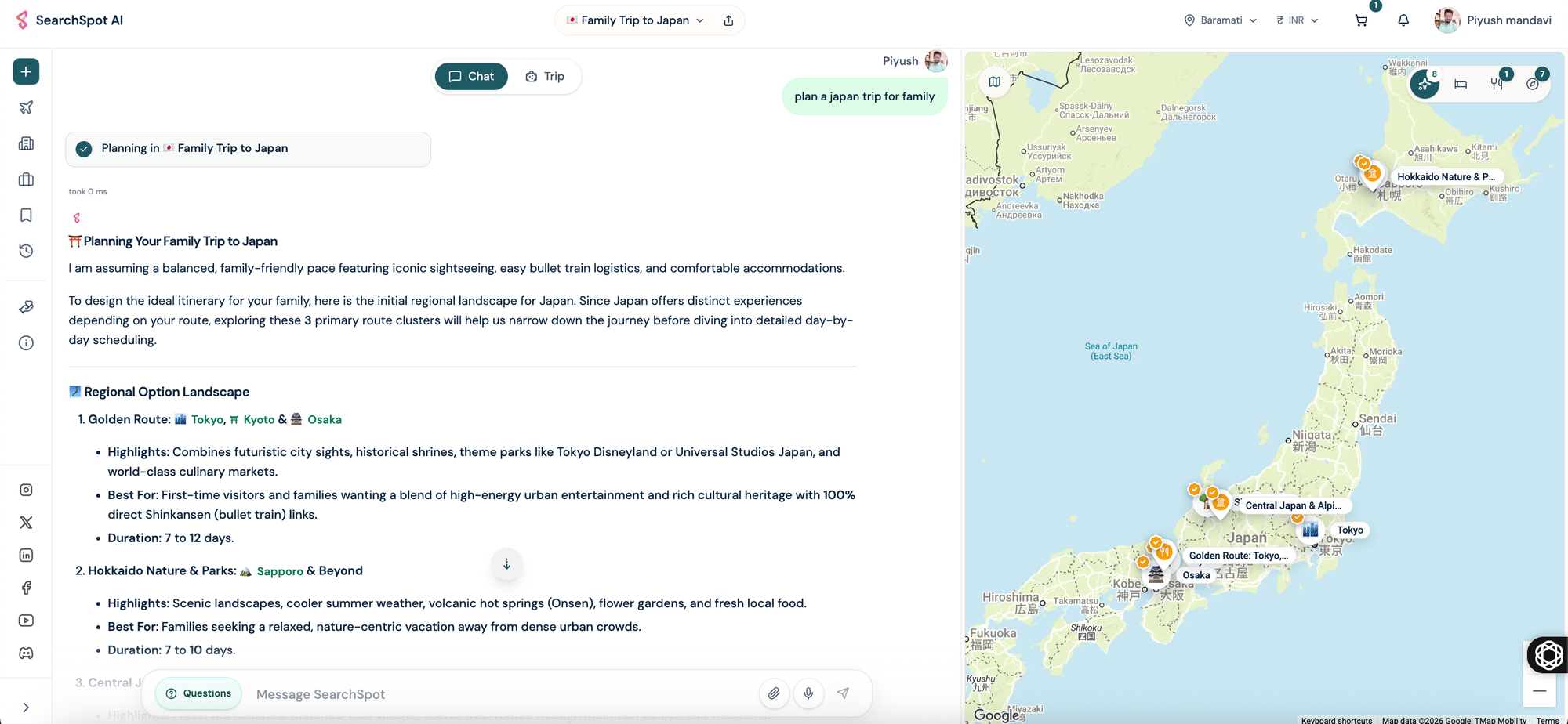
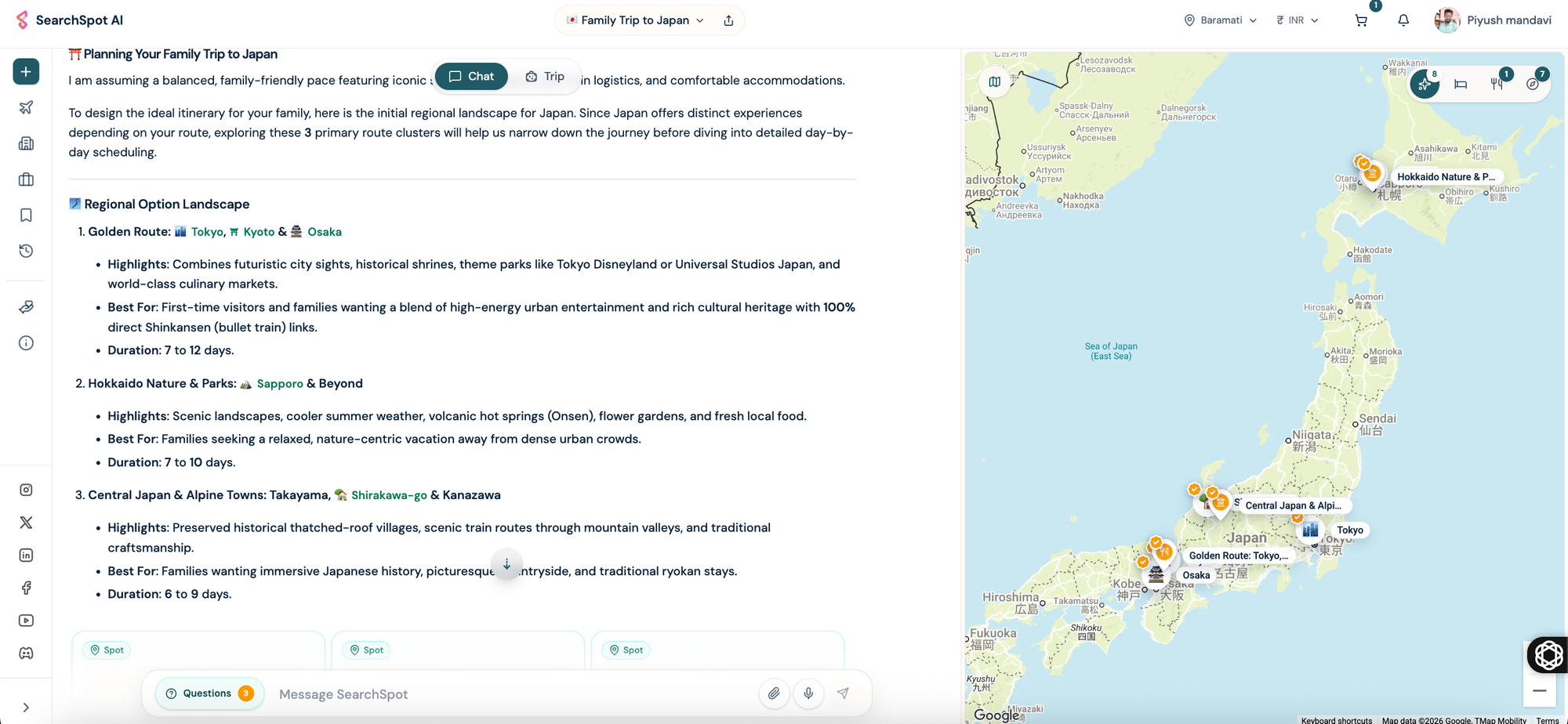
For this example, we used SearchSpot AI to explore a 20-day family trip through Japan. The planning session started with a simple request to plan a Japan family trip and progressively added information about the travelers, dates, preferred route and budget.
The resulting plan focused on Japan's Golden Route — Tokyo, Hakone, Kyoto, Nara and Osaka — while allowing room for slower days and adjustments.
Important: This is a sample planning scenario, not a fixed quotation. Flight prices, hotel rates, transportation costs, weather and attraction availability can change. Confirm current prices and accessibility information before booking.
Why a Slower Japan Itinerary Makes Sense for Older Travelers
A 20-day trip gives a family considerably more flexibility than trying to squeeze the same destinations into one week.
Instead of changing hotels every couple of nights and moving between attractions continuously, you can build in:
- Dedicated rest days
- Longer stays in major cities
- Fewer unnecessary hotel changes
- Buffer time for transportation
- Less walking on consecutive days
- Flexible sightseeing days
- Time for slower cultural experiences
For elderly travelers, this can make the difference between a trip that feels enjoyable and one that feels exhausting.
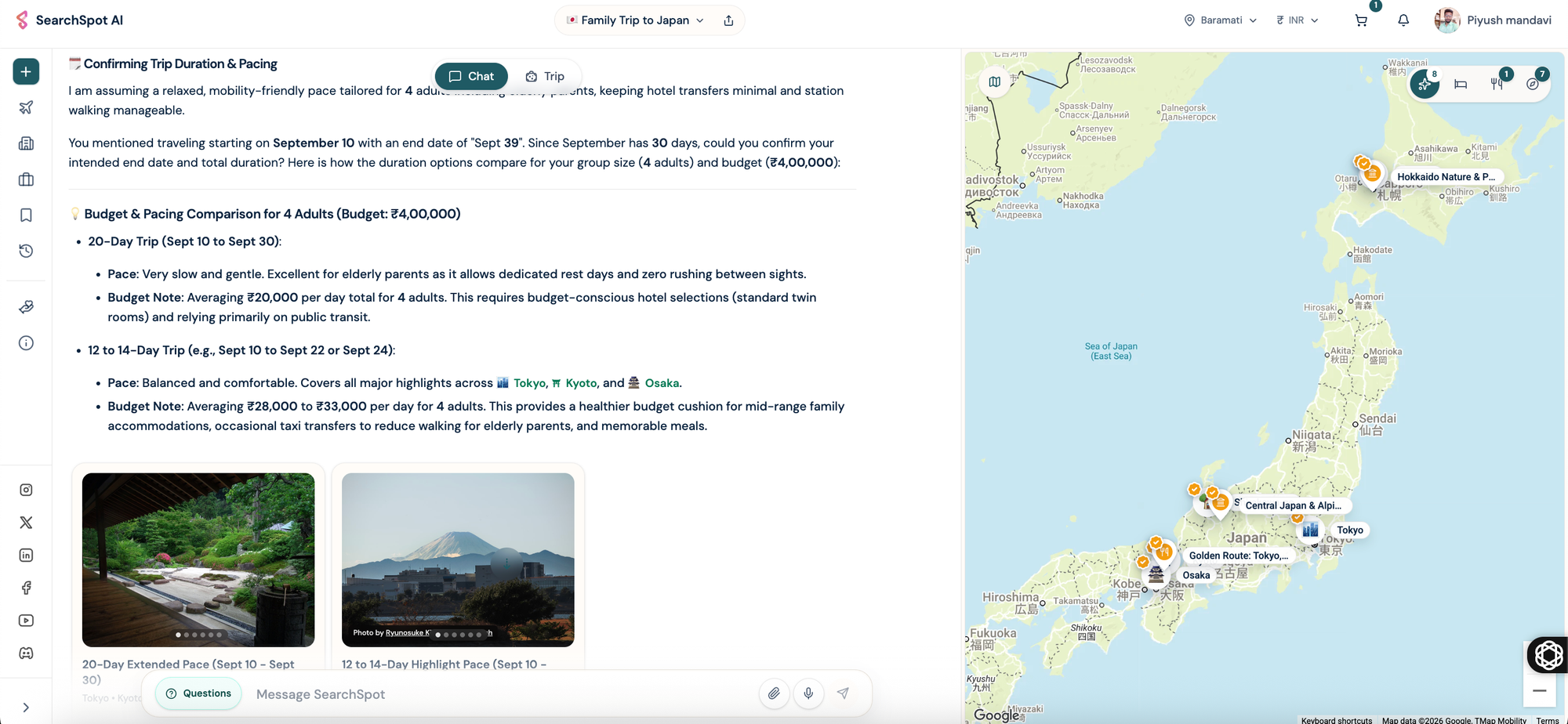
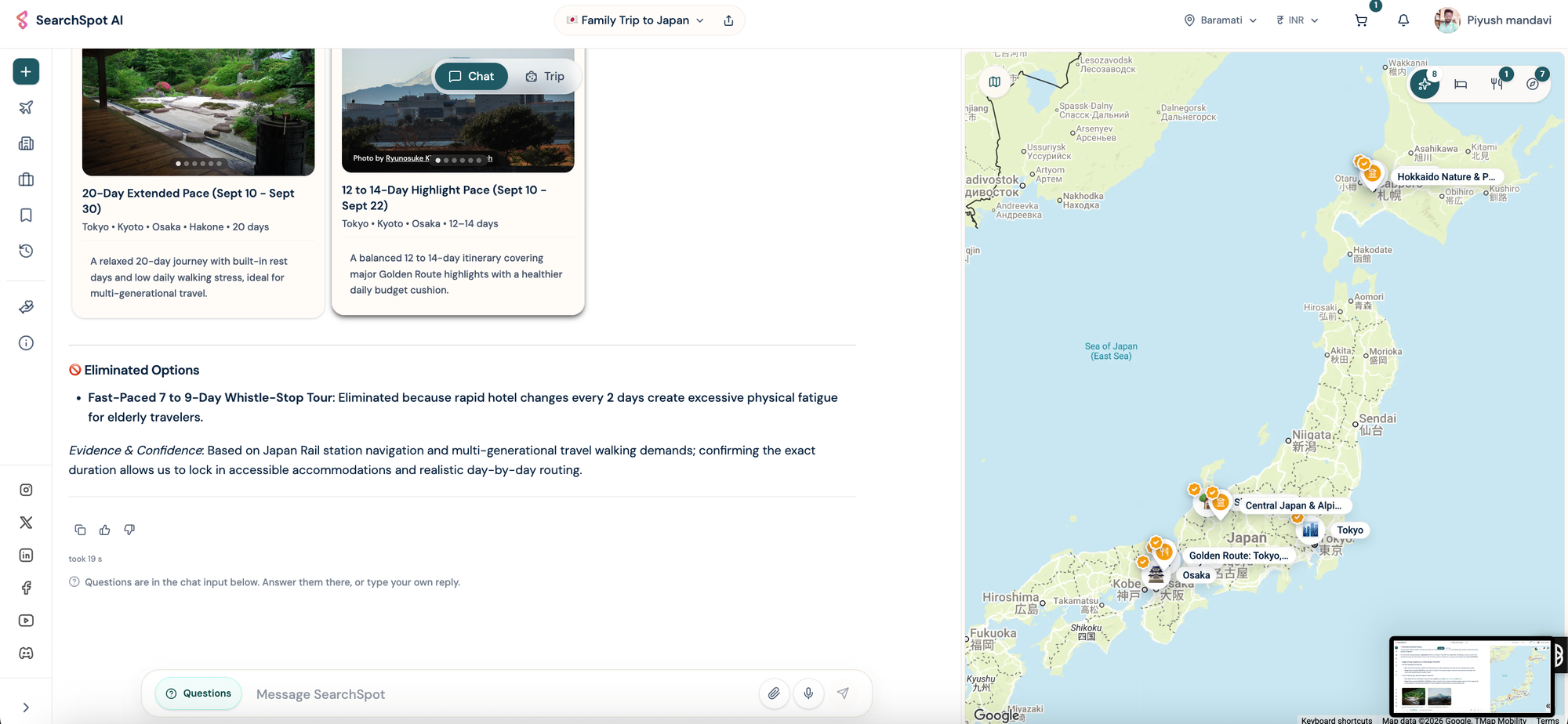
The original SearchSpot planning session specifically considered a slower pace, mobility needs and the trade-off between a longer trip and a shorter 12–14-day itinerary.
Japan Family Trip at a Glance
| Category | Plan |
|---|---|
| Travelers | 4 adults |
| Group | 2 adults + 2 elderly parents |
| Duration | 20 days |
| Route | Tokyo → Hakone → Kyoto → Nara → Osaka → Tokyo |
| Travel style | Relaxed and mobility-conscious |
| Accommodation | 4-star hotels + ryokan in Hakone |
| Budget target | ₹4,00,000* |
| Main cities | Tokyo, Kyoto & Osaka |
| Side trips | Hakone and Nara |
*The budget should be treated as a planning target rather than a guaranteed total. Clarify whether international flights are included before booking.
The Recommended Route
For a first family trip to Japan, the classic Golden Route is a practical starting point:
Tokyo → Hakone → Kyoto → Nara → Osaka
It combines major cities, traditional culture, food, scenery and shorter regional excursions without requiring the family to cross the entire country.
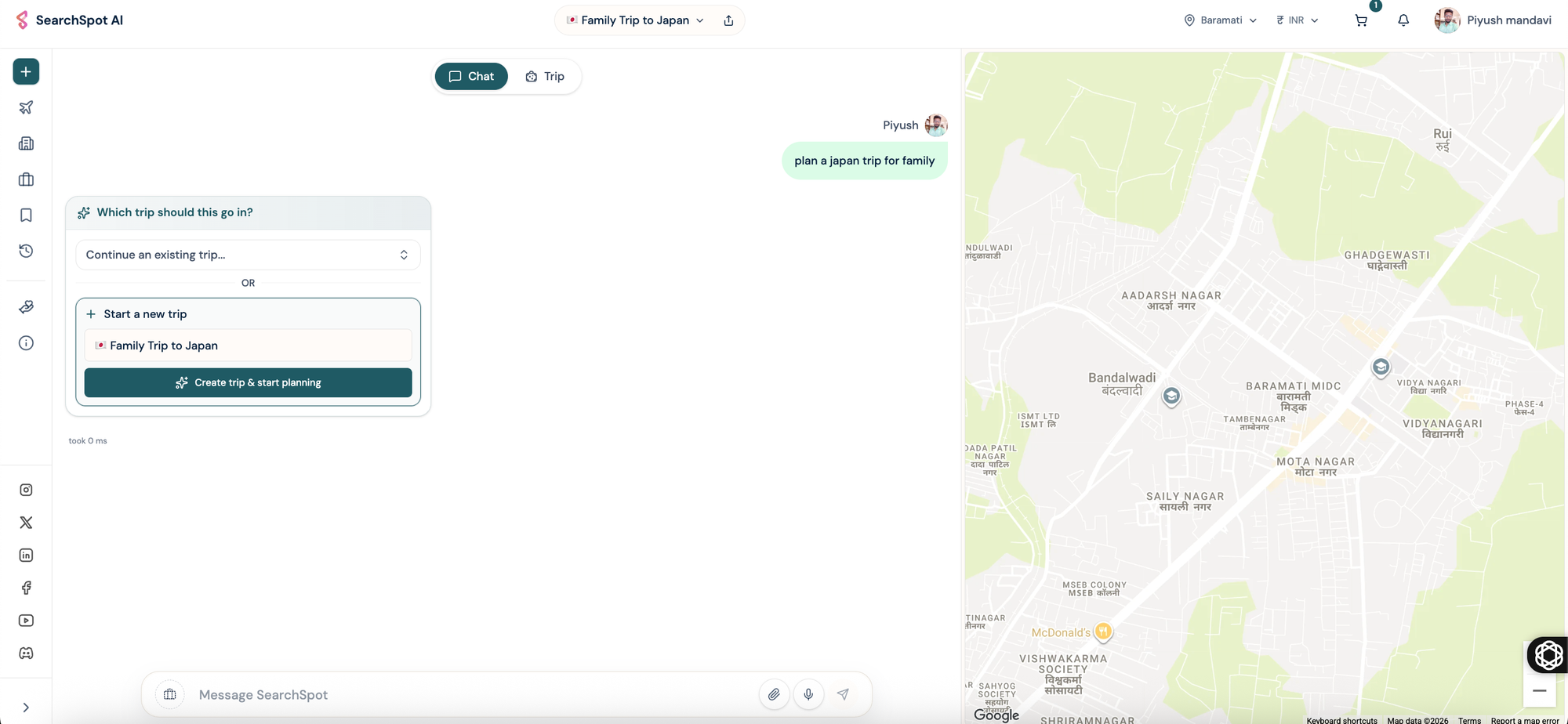
SearchSpot's initial Japan planning session also identified several alternative regional approaches before narrowing the trip toward the Golden Route. These included Hokkaido and Central Japan's alpine towns.
For a 20-day trip with elderly parents, however, keeping the route relatively concentrated can reduce unnecessary long-distance transfers.
20-Day Japan Itinerary
Phase 1: Tokyo — Days 1–6
Tokyo deserves several days because there is a huge amount to see, but the itinerary shouldn't require the family to walk from morning until night.
Day 1 — Arrival in Tokyo
Keep the first day deliberately light.
- Arrive in Tokyo
- Transfer to your hotel
- Check in and rest
- Have dinner close to the hotel
- Avoid scheduling major sightseeing
- Give everyone time to recover from the flight
For older travelers, the first day should be about settling in rather than maximizing sightseeing.
Day 2 — Easy Tokyo Introduction
Start with relatively straightforward attractions.
Morning: Imperial Palace area
Afternoon: Ginza
Evening: Choose a low-effort attraction or return to the hotel early.
Keep the day flexible depending on jet lag and energy.
Day 3 — Traditional Tokyo
Explore some of Tokyo's historic side.
Morning: Senso-ji and Asakusa
Lunch: Local Japanese restaurant
Afternoon: Tokyo National Museum or another nearby attraction
Evening: Return to the hotel or enjoy dinner close by.
Avoid combining too many distant neighborhoods in one day.
Day 4 — Rest Day
This should be a genuine rest day.
- Sleep in
- Hotel breakfast
- Optional short walk
- Relax at the hotel
- Casual dinner nearby
You can add a light attraction if everyone feels energetic, but there is no need to fill the day.
This is one of the biggest advantages of having 20 days instead of trying to complete the Golden Route in a week.
Day 5 — Modern Tokyo
Morning: Shibuya
Afternoon: Tokyo Skytree or another major attraction
Evening: Akihabara or a relaxed dinner
Keep the evening optional.
Day 6 — Kamakura or Yokohama
Use this as a flexible day trip.
Option A: Kamakura
- Great Buddha
- Hase-dera
- Traditional streets
- Return to Tokyo
Option B: Yokohama
Choose Yokohama instead if the family prefers a more urban and less temple-focused day.
If the family is tired after five days of travel, simply turn Day 6 into another rest day.
Phase 2: Hakone — Days 7–8
Hakone gives the itinerary a slower change of pace.
Day 7 — Tokyo to Hakone
Travel from Tokyo to Hakone and check into a ryokan.
The main goal is not to pack the day with attractions.
Instead:
- Travel to Hakone
- Check in
- Explore the property
- Have a traditional dinner
- Enjoy the onsen if appropriate
- Rest
A traditional ryokan stay can become one of the memorable experiences of the trip.
Day 8 — Hakone
Keep the sightseeing flexible.
Possible activities include:
- Owakudani
- Lake Ashi
- Hakone sightseeing cruise
- Hakone Open-Air Museum
- Onsen experience
Don't attempt every attraction.
If weather or fatigue makes sightseeing difficult, simply enjoy the ryokan and surrounding area.
Phase 3: Kyoto — Days 9–13
Kyoto is where pacing becomes particularly important.
Many famous areas involve walking, slopes, stairs or crowded streets. The goal should be to experience Kyoto without turning every day into a physical challenge.
Day 9 — Hakone/Tokyo to Kyoto
Travel to Kyoto and check into the hotel.
Keep the rest of the day light.
Possible evening:
- Dinner near the hotel
- Short walk
- Early rest
Day 10 — Eastern Kyoto
Explore:
- Kiyomizu-dera
- Sannenzaka
- Ninenzaka
- Yasaka Shrine
- Gion area
Don't try to cover everything.
For elderly travelers, take breaks whenever necessary and check current accessibility information for individual attractions before visiting.
Day 11 — Arashiyama
Start early if the family is comfortable doing so.
Possible itinerary:
- Arashiyama Bamboo Grove
- Tenryu-ji
- Lunch
- Optional river or scenic activity
Keep the afternoon flexible.
If the group is tired, return to the hotel instead of adding another attraction.
Day 12 — Kyoto Rest Day
Another deliberately slow day.
Options include:
- Hotel breakfast
- Relaxing morning
- Nishiki Market
- Café or tea experience
- Optional cultural event
- Early dinner
The purpose of this day is recovery.
Day 13 — Western Kyoto
Possible attractions:
- Kinkaku-ji
- Ryoan-ji
- Nijo Castle
Fushimi Inari can be offered as an optional activity rather than a mandatory stop because the upper trail involves significant walking and stairs.
For an elderly family group, "optional" is often better than "must-see."
Phase 4: Nara — Day 14
Day 14 — Kyoto to Nara and Back
Nara works well as a day trip from Kyoto.
Possible stops include:
- Todai-ji
- Nara Park
- Kasuga Taisha
Spend enough time in each location without trying to see every attraction.
Return to Kyoto for the evening rather than changing hotels again.
This keeps the overall route simpler.
Phase 5: Osaka — Days 15–18
Day 15 — Kyoto to Osaka
Travel to Osaka and check into the hotel.
Possible afternoon:
- Dotonbori
- Local food
- Relaxed evening
Choose a hotel close to convenient transportation rather than prioritizing a specific neighborhood solely for its name.
Day 16 — Osaka Highlights
Possible attractions:
- Osaka Castle
- Shinsekai
- Kuromon Market
- Umeda area
Keep the number of stops manageable.
Day 17 — Universal Studios Japan or Alternative Day
This should depend entirely on the family's interests and energy.
Option A: Universal Studios Japan
Good for travelers who genuinely want to spend a full day at the park.
Option B: Osaka Aquarium Kaiyukan
A potentially less physically demanding alternative.
Option C: Rest day
If the family has already done a lot of sightseeing, there is nothing wrong with doing less.
Day 18 — Osaka Rest Day
Use the day for:
- Hotel relaxation
- Shopping
- Café visits
- Light sightseeing
- Optional Umeda visit
- Farewell dinner
Phase 6: Return to Tokyo — Days 19–20
Day 19 — Osaka to Tokyo
Return to Tokyo.
Keep this day simple.
Possible activities:
- Tokyo Station
- Ginza
- Last-minute shopping
- Dinner near the hotel
Staying near the airport can make the final morning easier if the flight is early.
Day 20 — Departure
Keep the final day focused on getting to the airport without unnecessary sightseeing.
Allow extra time for luggage, transportation and airport procedures.
How to Make This Itinerary More Comfortable for Elderly Parents
The biggest mistake with a family Japan trip is trying to optimize for maximum attractions per day.
Instead, optimize for energy and convenience.
1. Reduce hotel changes
Every hotel change means:
- Packing
- Checking out
- Getting to a station
- Handling luggage
- Traveling
- Checking in
- Settling into a new room
Reducing these transitions can make a major difference.
2. Don't schedule heavy walking days consecutively
A temple-heavy Kyoto day followed by another major sightseeing day can be exhausting.
Alternate demanding days with lighter ones.
3. Keep mornings flexible
Don't make every day start at 6 AM.
A relaxed breakfast can be more valuable than squeezing another attraction into the itinerary.
4. Use taxis strategically
Public transportation is extremely useful in Japan, but taxis can be worthwhile when:
- The family is tired
- Luggage is involved
- A route requires multiple transfers
- Walking between stations and attractions becomes uncomfortable
5. Check accessibility before visiting
Don't assume that an attraction described as "elderly-friendly" is automatically wheelchair-accessible or suitable for every mobility level.
Check:
- Stairs
- Elevators
- Walking distances
- Seating
- Restrooms
- Terrain
- Current accessibility arrangements
Transportation Strategy
The original planning output considered the major Tokyo–Kyoto–Osaka rail connections and local transportation.
However, don't automatically buy a nationwide JR Pass simply because you'll use several Shinkansen journeys.
The right choice depends on:
- Your exact route
- Number of long-distance journeys
- Current JR Pass pricing
- Individual ticket prices
- Travel dates
- Whether regional passes offer better value
Before booking transportation, compare:
Option 1: Individual Shinkansen tickets
Option 2: Nationwide JR Pass
Option 3: Regional rail passes
For a family of four, even a relatively small per-person price difference can significantly affect the total budget.
Accommodation Strategy
For elderly travelers, location is often more important than having a slightly nicer hotel.
Prioritize:
- Easy station access
- Elevators
- Nearby restaurants
- Comfortable rooms
- Accessible bathrooms where needed
- Minimal walking from transportation
- Flexible cancellation policies
The original plan used a 4-star accommodation target and included a ryokan stay in Hakone.
Rather than treating the stated hotel budget as a guaranteed price, use it as a planning range and check current rates for your actual dates.
Budget Planning
The original scenario used a ₹4,00,000 total planning budget.
Before using that number as a final trip budget, clarify whether it includes:
- International flights
- Hotels
- Rail tickets
- Local transportation
- Food
- Attractions
- Travel insurance
- Shopping
- Airport transfers
If international flights are included, ₹4 lakh for four people may require a significantly different itinerary and accommodation strategy.
If flights are excluded, the same budget provides much more flexibility.
A better way to budget
Divide your total budget into:
Accommodation
Transportation
Food
Attractions
Insurance
Emergency buffer
Flights
Then adjust the itinerary based on the largest variable costs.
Japan Travel Tips for Families With Elderly Parents
Do
- Leave buffer time between major activities
- Keep luggage transfers manageable
- Use taxis when they significantly reduce walking
- Reserve important transportation in advance when appropriate
- Choose hotels near convenient transportation
- Carry necessary medications
- Keep a flexible day in the itinerary
- Check attraction accessibility before visiting
Avoid
- Several consecutive days of intense sightseeing
- Constant hotel changes
- Very early departures every morning
- Assuming every attraction is accessible
- Building the entire trip around a rigid schedule
- Spending the entire budget before leaving an emergency buffer
Japan Cultural Etiquette
A few basic customs make the trip easier:
- Keep your voice low on trains.
- Follow local rules when visiting temples and shrines.
- Remove shoes where required.
- Follow onsen bathing rules.
- Avoid placing chopsticks vertically in rice.
- Tipping is generally not customary in Japan.
- Be mindful of priority seating on public transportation.
- Follow photography rules at temples, museums and other attractions.
These simple habits help make the trip more comfortable for both your family and the people around you.
Pre-Departure Checklist
4–8 Weeks Before
- Confirm passport and visa requirements for your nationality.
- Purchase appropriate travel insurance.
- Book accommodation.
- Reserve the Hakone ryokan if included.
- Review transportation options.
- Check cancellation policies.
- Organize medications and prescriptions.
2–4 Weeks Before
- Finalize major transportation.
- Reserve attractions that require advance booking.
- Check accessibility arrangements.
- Confirm airport transfers.
- Download useful travel apps and maps.
One Week Before
- Check the weather forecast.
- Check transportation updates.
- Confirm hotel reservations.
- Keep digital copies of important documents.
- Prepare medications and essential items.
- Keep some flexibility in the schedule for weather disruptions.
How SearchSpot AI Helped Build This Itinerary
The itinerary above came from a real SearchSpot planning workflow.
The process began with:
"Plan a Japan trip for family."
SearchSpot then identified several possible regional approaches before asking questions about the travelers, travel dates, preferred route and budget.
For our test, the group was specified as two adults and elderly parents, with a ₹4,00,000 budget and the Golden Route selected. The system then compared different trip durations and pacing options.
One particularly useful part of the workflow was that it didn't simply generate a final itinerary immediately.
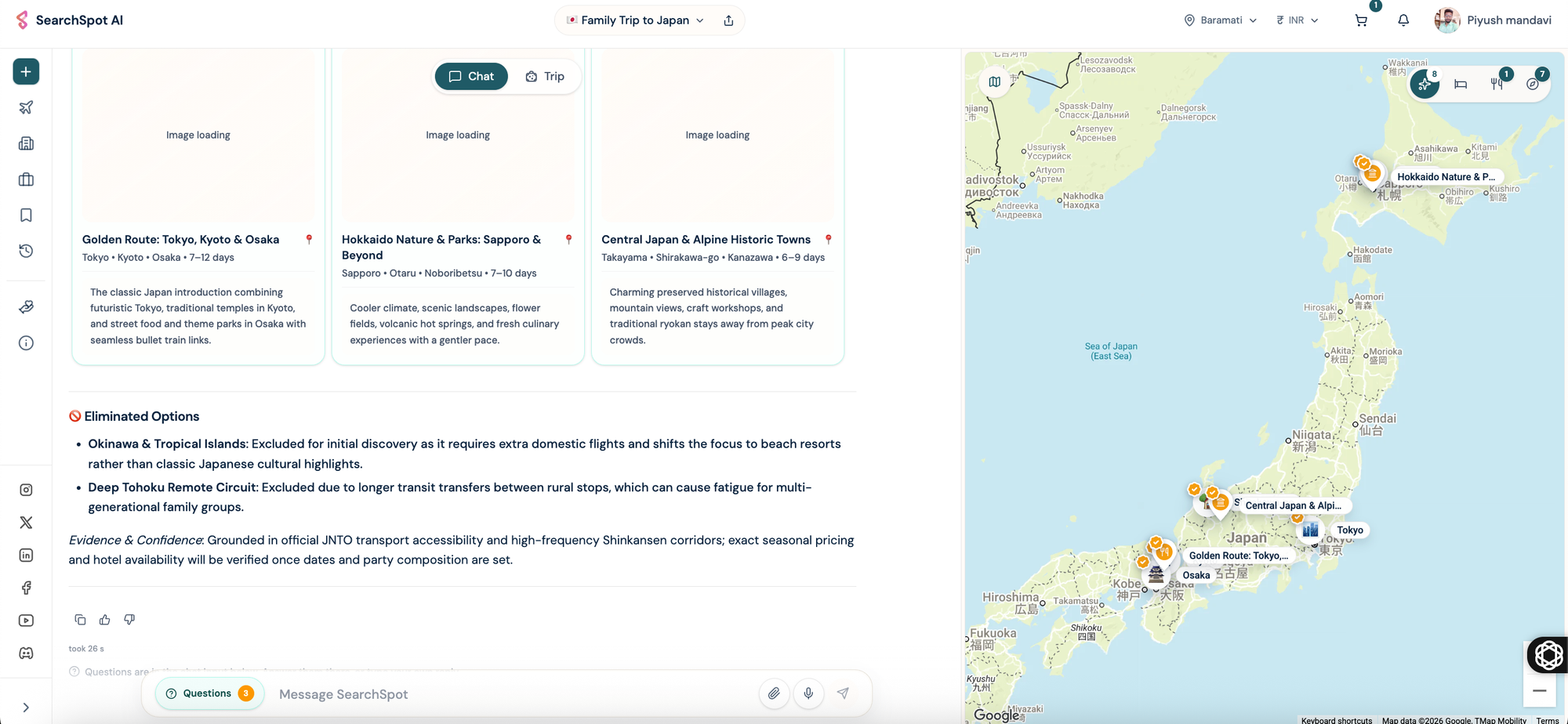
It also showed eliminated options and the reasons behind them.
That makes the tool useful not only for answering:
"Where should I go?"
but also:
"Which route makes the most sense for my particular group?"
Why We Prefer a 20-Day Plan for This Example
A shorter trip isn't necessarily a bad trip.
In fact, a 12–14-day Japan itinerary can work very well for travelers who want a faster introduction to Tokyo, Kyoto and Osaka.
But with elderly parents, the additional days provide something valuable:
flexibility.
You can have a rest day without feeling like you've sacrificed one of your only vacation days.
You can take a taxi when someone is tired.
You can spend longer at a place everyone enjoys.
You can change plans if the weather is poor.
And you don't have to treat every morning as a race to the next attraction.
That's the real benefit of extending the trip.
Final 20-Day Route
Tokyo — 6 nights
Tokyo sightseeing + rest day + optional Kamakura/Yokohama
↓
Hakone — 2 nights
Ryokan + onsen + scenic sightseeing
↓
Kyoto — 5 nights
Eastern Kyoto + Arashiyama + rest day + Western Kyoto
↓
Nara — Day Trip
Todai-ji + Nara Park + return to Kyoto
↓
Osaka — 4 nights
Osaka sightseeing + optional USJ + rest day
↓
Tokyo — final night / departure logistics
This keeps the trip focused on a manageable number of destinations rather than trying to cover all of Japan.
Final Thoughts
A good Japan itinerary for elderly parents isn't about seeing the most places.
It's about creating enough space between the places.
The 20-day format gives this family the ability to slow down, take rest days, reduce unnecessary transfers and adapt the schedule when someone gets tired.
The route also covers many of the experiences first-time visitors want:
Tokyo's modern city life → Hakone's scenery and ryokan experience → Kyoto's traditional culture → Nara's historic sights → Osaka's food and entertainment.
And because the itinerary was created through SearchSpot's conversational planning workflow, the route can be adjusted as the family's requirements change.
That's ultimately what makes AI trip planning useful: not replacing your decisions, but helping you understand the trade-offs before you make them.
FAQ
How many days are enough for Japan with elderly parents?
There is no single ideal duration, but a longer trip allows more rest days and fewer rushed sightseeing days. For a multi-generational first trip, around two to three weeks can provide useful flexibility.
Is Tokyo, Kyoto and Osaka a good route for elderly travelers?
Yes, it can be a practical first-trip route because the cities are connected by frequent rail services and offer very different experiences. The itinerary should still be designed around walking ability and rest requirements.
Is 20 days too long for Japan?
Not necessarily. A 20-day trip gives you more flexibility to include rest days, Hakone, Nara and slower sightseeing rather than simply adding more destinations.
Should elderly parents travel to Japan?
Japan can be an excellent destination for a family trip, but suitability depends on individual mobility, health, walking tolerance and travel preferences. Check specific attractions and transportation arrangements before booking.
Can AI plan a Japan family trip?
Yes. AI trip planners can help compare destinations, build routes, consider budgets and create day-by-day itineraries. However, travelers should verify current prices, opening hours, transportation schedules, weather and accessibility information before relying on an itinerary.
Can SearchSpot AI plan trips for families?
Yes. SearchSpot can incorporate group size, traveler requirements, dates, budget and preferred travel style into the planning conversation.
Can SearchSpot AI compare different trip lengths?
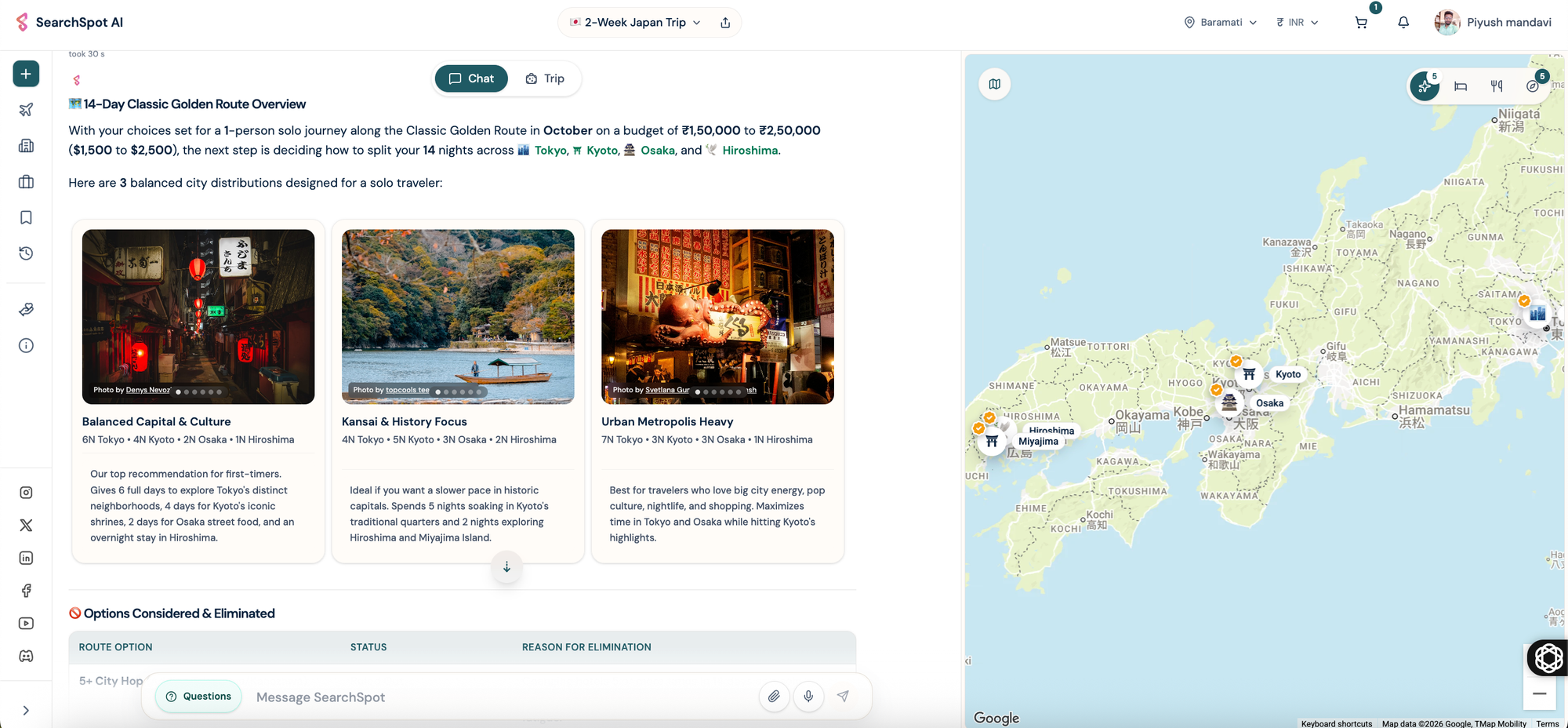
Yes. In our Japan planning test, SearchSpot compared a longer 20-day itinerary with shorter 12–14-day options and explained the trade-offs in pace and budget.
About This Itinerary
This itinerary is based on a hands-on SearchSpot AI planning session using a Japan family-trip scenario involving four adults, elderly parents, a 20-day timeframe, the Golden Route and a ₹4,00,000 planning budget.
The itinerary should be treated as a planning example rather than a booking-ready travel schedule. Prices, transportation schedules, hotel availability, weather and attraction accessibility can change, so verify important details using current official sources before traveling.
Last updated: August 2026
 Hiten Sethiya

Turn this research into a real trip plan
SearchSpot helps you compare stays, routes, neighborhoods, and decision tradeoffs in one planning flow so you can move from reading to booking with more confidence.