
What's the Best AI Trip Planner in 2026? I Tested 8 to Find Out
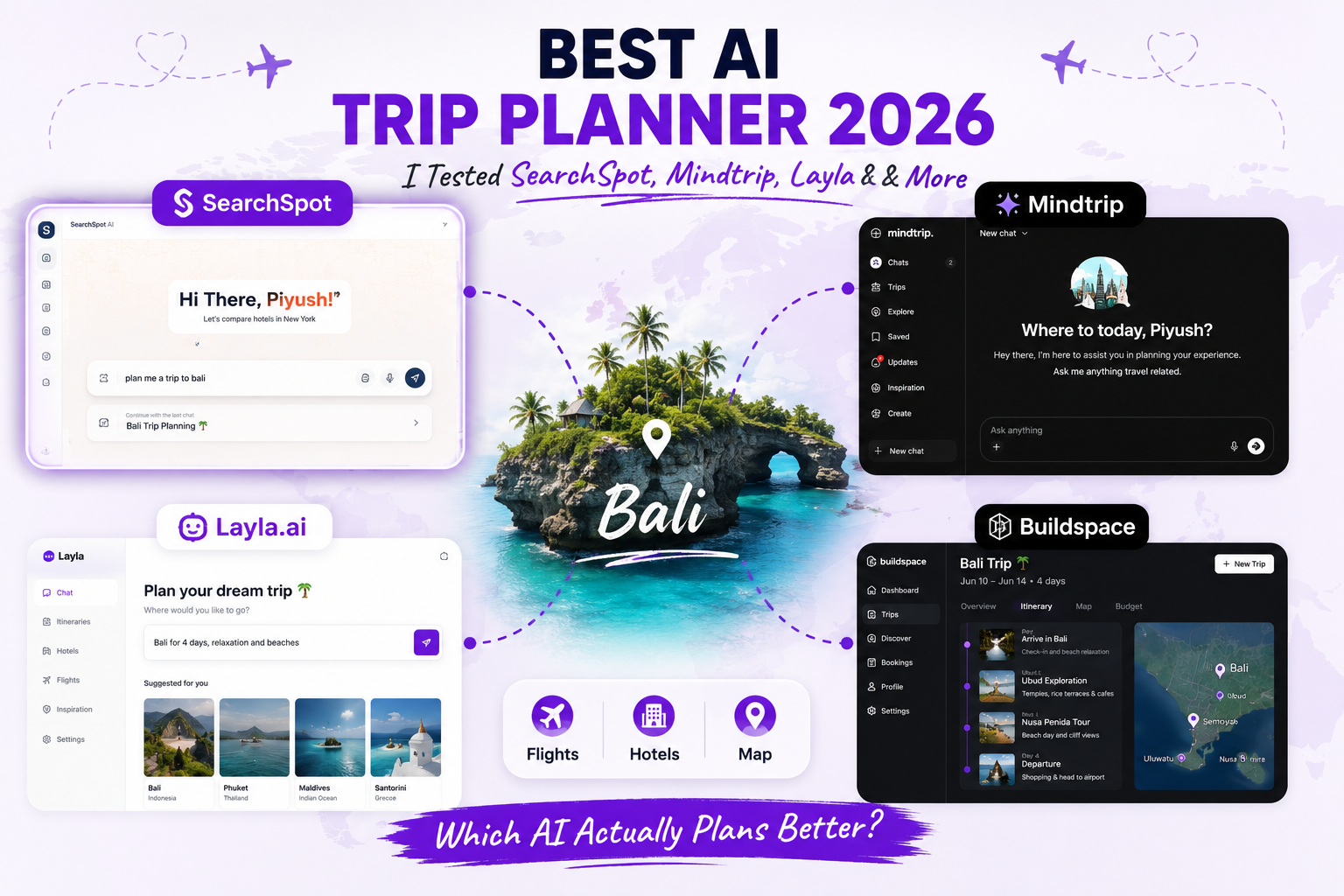
Planning your next trip? We compared the best AI trip planners of 2026, including SearchSpot, Mindtrip, ChatGPT, Wonderplan, GuideGeek, and more. Discover which AI travel planner offers the best itineraries, features, and value for your next adventure.


Planning your next holiday? We tested the best AI trip planners of 2026—including SearchSpot, Mindtrip, Layla, Wonderplan, Trip Planner AI, ChatGPT, and more—to help you find the right travel companion.
Planning a Trip Should Be Exciting, Not Exhausting
There was a time when planning a holiday meant opening what felt like an endless number of tabs.
One tab for flights.
Another for hotels.
Five more for YouTube videos.
Then Reddit.
Then Google Maps.
Then a blog recommending "hidden gems" that turned out to be anything but hidden.
By the end of it, you weren't planning a trip anymore—you were managing a research project.
That's exactly why AI trip planners have become so popular over the past few years.
Instead of spending hours deciding where to go next, you can simply describe the kind of trip you want. Maybe it's a week in Japan during cherry blossom season, a budget-friendly backpacking adventure through Southeast Asia, or a relaxing honeymoon in Italy. Within seconds, an AI planner can suggest an itinerary, estimate costs, recommend places to stay, and even adjust the plan if your preferences change.
But here's something I noticed after trying dozens of these tools.
Not all AI trip planners are actually good.
Some generate beautiful-looking itineraries that fall apart the moment you check opening hours.
Others recommend restaurants that closed months ago.
A few are little more than ChatGPT wrapped inside a travel-themed website.
And then there are the tools that genuinely make planning feel easier.
This article isn't just another list of travel apps.
I spent time comparing the most popular AI trip planners available in 2026 to understand where each one shines, where it struggles, and which type of traveller it suits best.
Whether you're travelling solo, with family, as a couple, or planning a multi-city adventure with friends, you'll hopefully finish this guide knowing exactly which AI travel planner deserves your attention.
Quick Comparison: Best AI Trip Planners in 2026
| AI Trip Planner | Best For | Free Plan | Booking Support | Personalisation | Overall Rating |
|---|---|---|---|---|---|
| SearchSpot | Best Overall | ✅ | ✅ | ⭐⭐⭐⭐⭐ | 9.8/10 |
| Mindtrip | Inspiration & Discovery | ✅ | ✅ | ⭐⭐⭐⭐☆ | 9.4/10 |
| Layla | Conversational Planning | ✅ | Limited | ⭐⭐⭐⭐☆ | 9.2/10 |
| Wonderplan | Free Itineraries | ✅ | ❌ | ⭐⭐⭐⭐☆ | 9.0/10 |
| Trip Planner AI | Multi-City Trips | ✅ | ✅ | ⭐⭐⭐⭐☆ | 8.9/10 |
| ChatGPT | Flexible Planning | ✅ | ❌ | ⭐⭐⭐⭐☆ | 8.8/10 |
| GuideGeek | Travel Chat | ✅ | ❌ | ⭐⭐⭐☆☆ | 8.6/10 |
| Roam Around | Quick Plans | ✅ | ❌ | ⭐⭐⭐☆☆ | 8.5/10 |
How I Compared These AI Trip Planners
Every travel website claims to be powered by artificial intelligence.
That doesn't automatically make it useful.
Rather than judging these tools based on flashy landing pages or marketing claims, I looked at what actually matters when you're trying to plan a real trip.
Here's what I focused on.
Itinerary Quality
Does the AI create a logical day-by-day schedule?
Or does it recommend visiting three museums on opposite sides of the city before lunch?
Personalisation
Can the planner adapt to different budgets, interests, travel styles, and trip lengths?
Or does every itinerary feel like the same template with different city names?
Flexibility
Travel plans change.
Flights get delayed.
Weather changes.
Friends cancel.
The best AI planners should make editing your itinerary simple instead of forcing you to start from scratch.
Booking Integration
Some AI planners stop after generating an itinerary.
Others let you compare hotels, flights, attractions, and transport without leaving the platform.
That saves a surprising amount of time.
Ease of Use
The smartest AI in the world isn't very helpful if using it feels like filling out tax forms.
I gave extra points to tools that make planning feel simple.
Overall Experience
Finally, I asked myself one question after testing each planner.
Would I actually use this to plan my own holiday?
That answer mattered more than any feature checklist.
1. SearchSpot – Best Overall AI Trip Planner
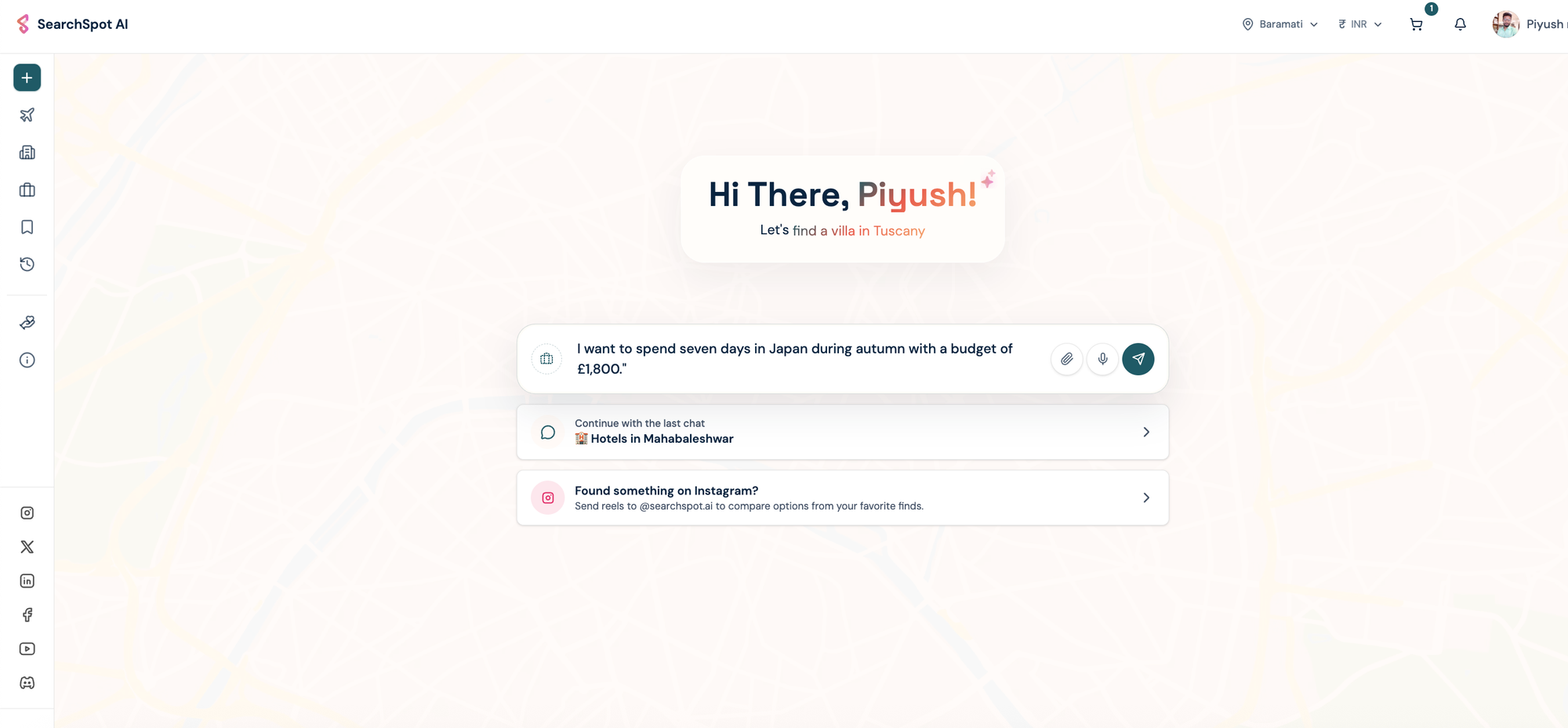
If someone asked me to recommend just one AI trip planner in 2026, SearchSpot would be the first name I'd mention.
Not because it tries to do everything.
But because it gets the important things right.
Most AI travel planners either focus on inspiration or itinerary generation.
SearchSpot feels like it was built around the complete planning experience.
You can start with a simple idea—
"I want to spend seven days in Japan during autumn with a budget of £1,800."
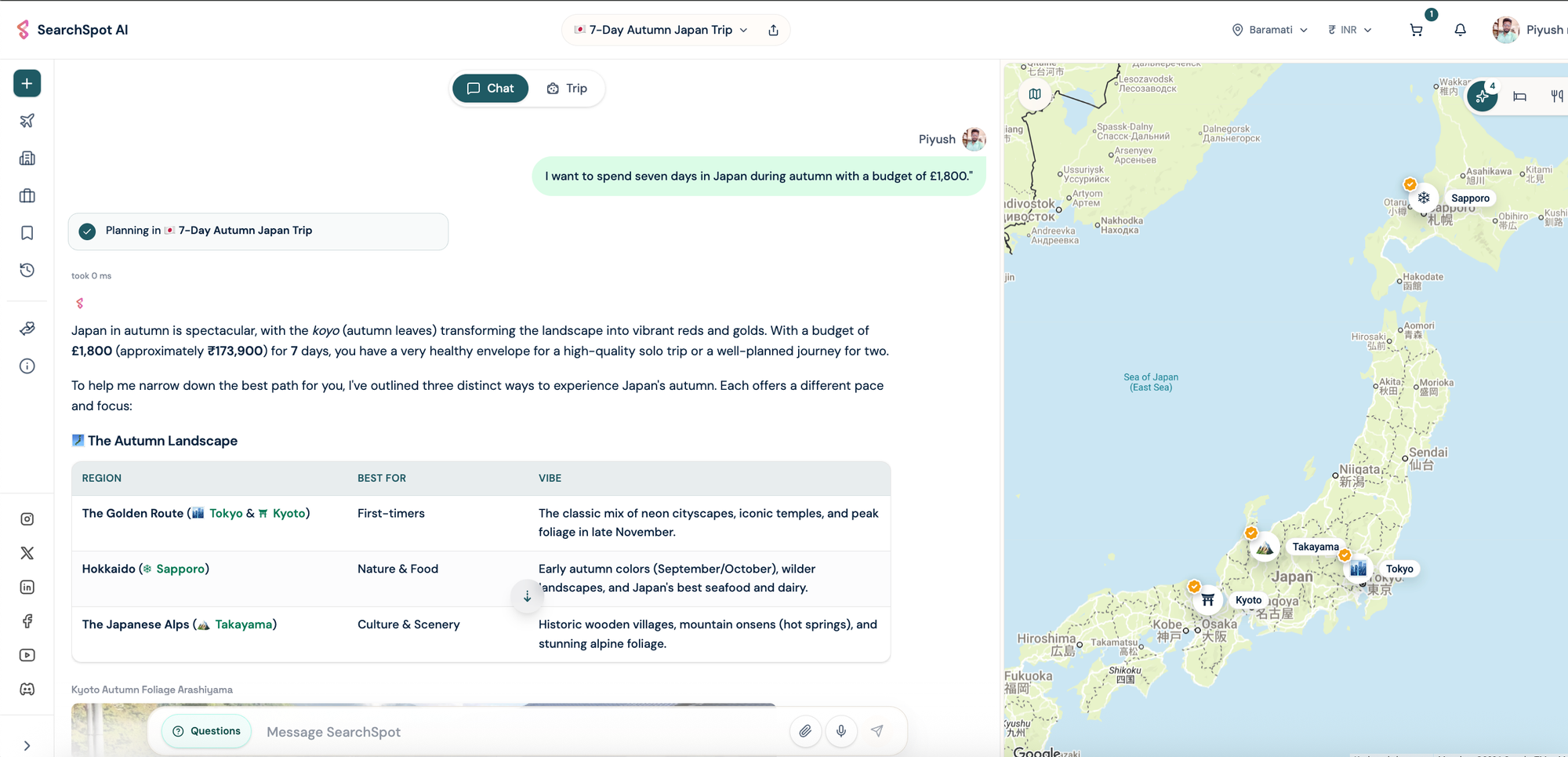
From there, the AI doesn't simply throw together a list of attractions.
It builds a trip that feels connected.
The suggested route makes sense.
Activities are grouped logically.
Travel time is considered.
The recommendations feel tailored instead of generic.
What I particularly liked was how easy it was to refine the itinerary.
Maybe you don't enjoy museums.
Maybe you'd rather spend more time exploring local cafés.
Maybe your budget suddenly changes.
Instead of generating a completely new plan, SearchSpot lets you keep improving the same itinerary until it feels right.
That's surprisingly rare.
What I liked
- Clean interface that doesn't overwhelm first-time users.
- Personalised itineraries that actually feel personal.
- Easy editing without restarting from scratch.
- Useful recommendations for attractions, accommodation, and local experiences.
- Suitable for solo travellers, couples, families, and group trips.
Where it could improve
No travel planner is perfect.
I'd love to see even deeper integrations with airlines and public transport in future updates.
Best for
Travellers who want one platform that handles inspiration, planning, and itinerary building without feeling complicated.
Overall Rating: 9.8/10
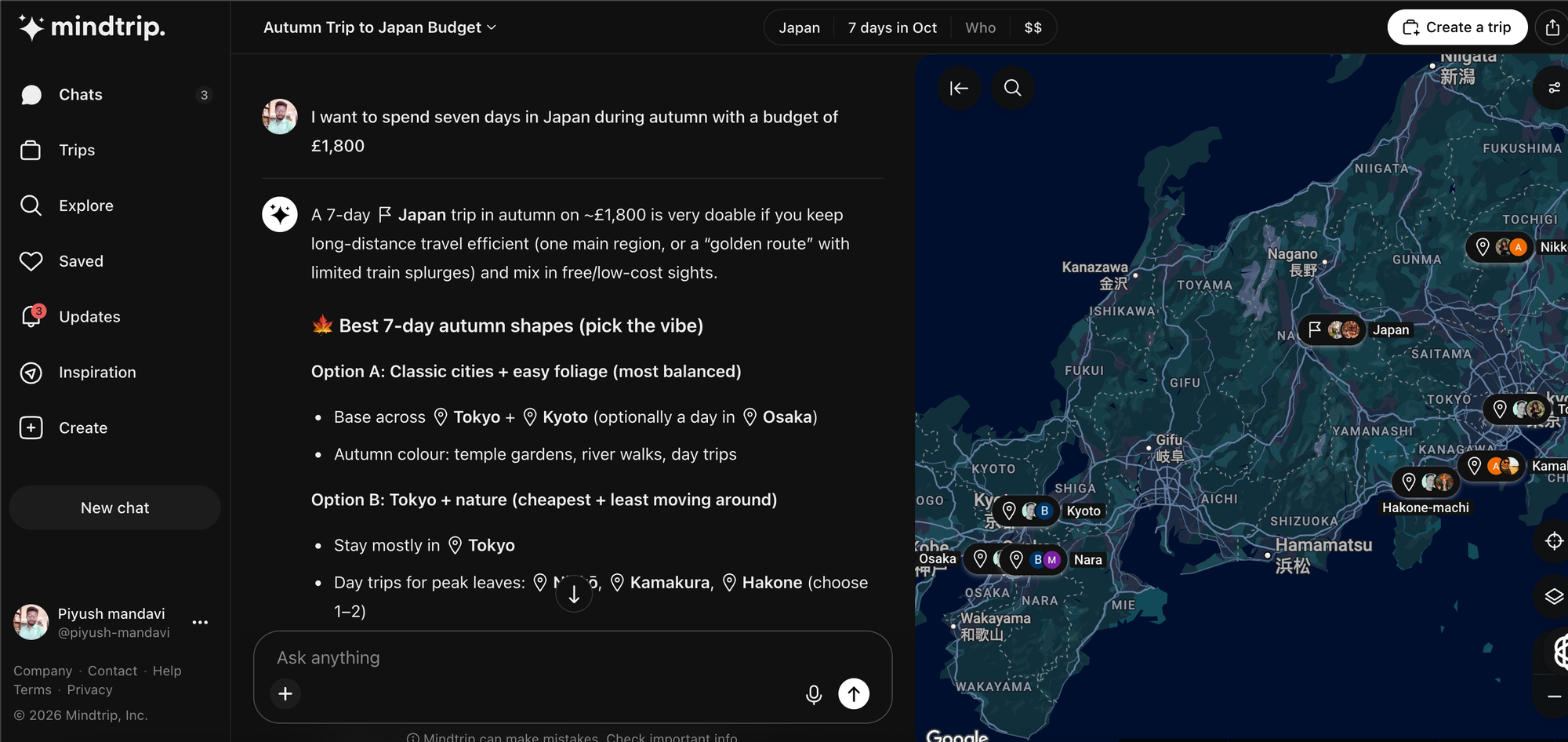
2. Mindtrip – Best for Travel Inspiration
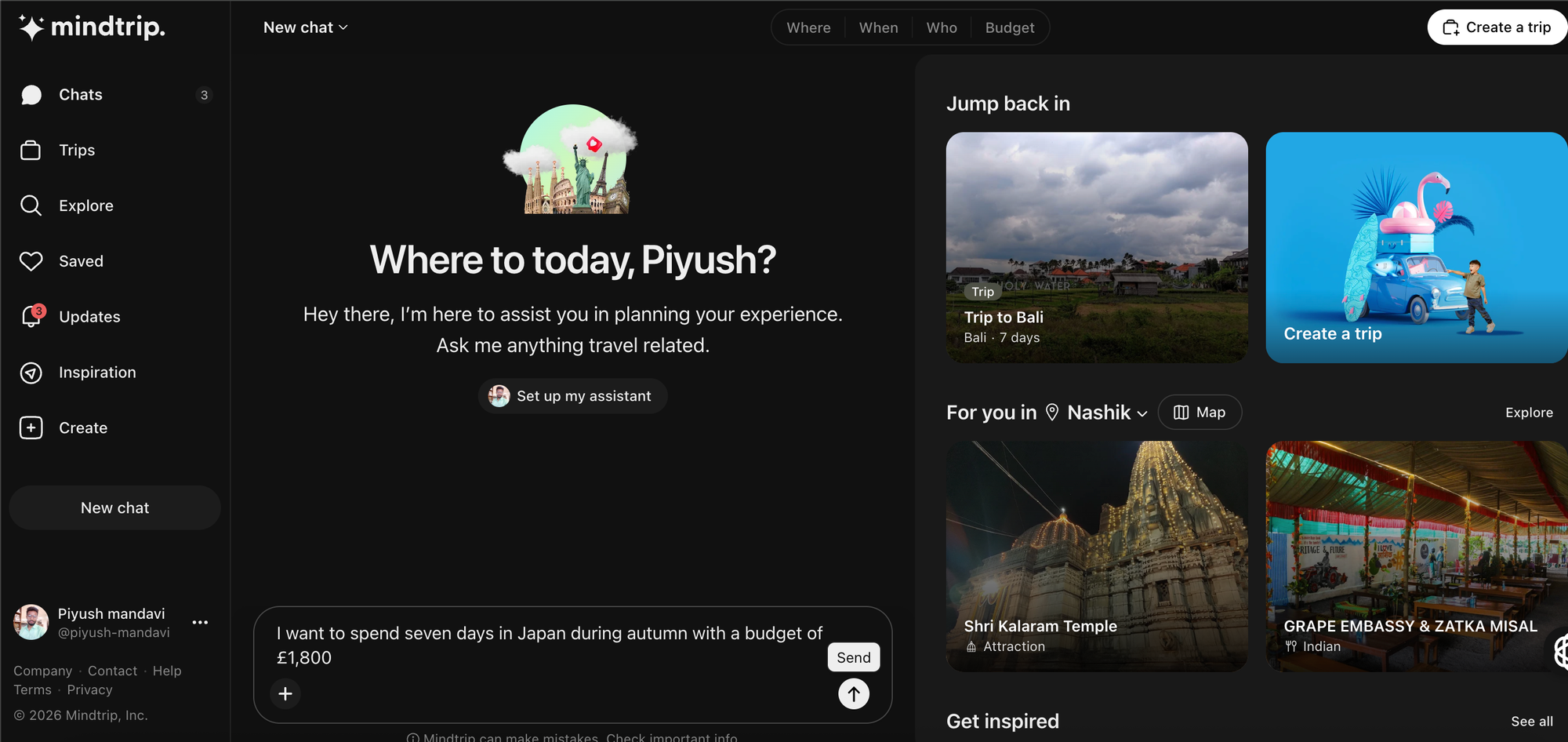
Some people already know where they're going.
Others just know they want a holiday.
That's where Mindtrip shines.
Instead of immediately asking for dates and budgets, it encourages exploration.
You can browse destinations, discover interesting places, and gradually build your itinerary as ideas come together.
Using Mindtrip feels a bit like talking to a well-travelled friend.
Rather than overwhelming you with options, it nudges you towards experiences you might not have considered.
If you're the type of traveller who enjoys discovering hidden cafés, scenic viewpoints, or neighbourhoods beyond the usual tourist attractions, you'll probably appreciate its approach.
The trade-off is that it sometimes focuses more on inspiration than logistics.
You'll still need to double-check timings, transport, and bookings before finalising your plans.
What I liked
- Great for travellers who haven't chosen a destination yet.
- Strong recommendations for attractions and experiences.
- Pleasant conversational interface.
- Easy to explore different trip ideas.
Where it could improve
Some itineraries need a bit more refinement before they're ready to use.
Best for
Travellers looking for inspiration before diving into detailed planning.
Overall Rating: 9.4/10
3. Layla – Best AI Trip Planner for Natural Conversations
If you've ever wished planning a trip felt more like chatting with a friend than filling out a form, Layla gets surprisingly close.
Instead of asking you to complete dozens of fields before generating an itinerary, Layla encourages conversation.
You might start with something as simple as:
"I want a relaxing week in Greece with great food and beautiful beaches."
From there, the AI asks follow-up questions, suggests destinations, recommends hotels, and slowly builds your trip.
It's a refreshing experience because it doesn't feel robotic.
What impressed me most wasn't necessarily the itinerary itself—it was how easy it was to keep refining it. You can change your budget, remove destinations, add experiences, or completely switch the pace of your holiday without starting from scratch.
The downside is that Layla still feels more like a travel assistant than a complete planning platform. If you're expecting deep booking integrations or detailed route optimisation, you'll probably need another tool alongside it.
What I liked
- Very natural conversation flow.
- Easy to modify itineraries.
- Great destination recommendations.
- Beginner-friendly interface.
What could be better
- Limited booking capabilities.
- Some recommendations can feel repetitive on longer trips.
Best for: Travellers who like planning through conversation rather than forms.
Rating: 9.2/10
 Layla
Layla
4. Wonderplan – Best Free AI Trip Planner
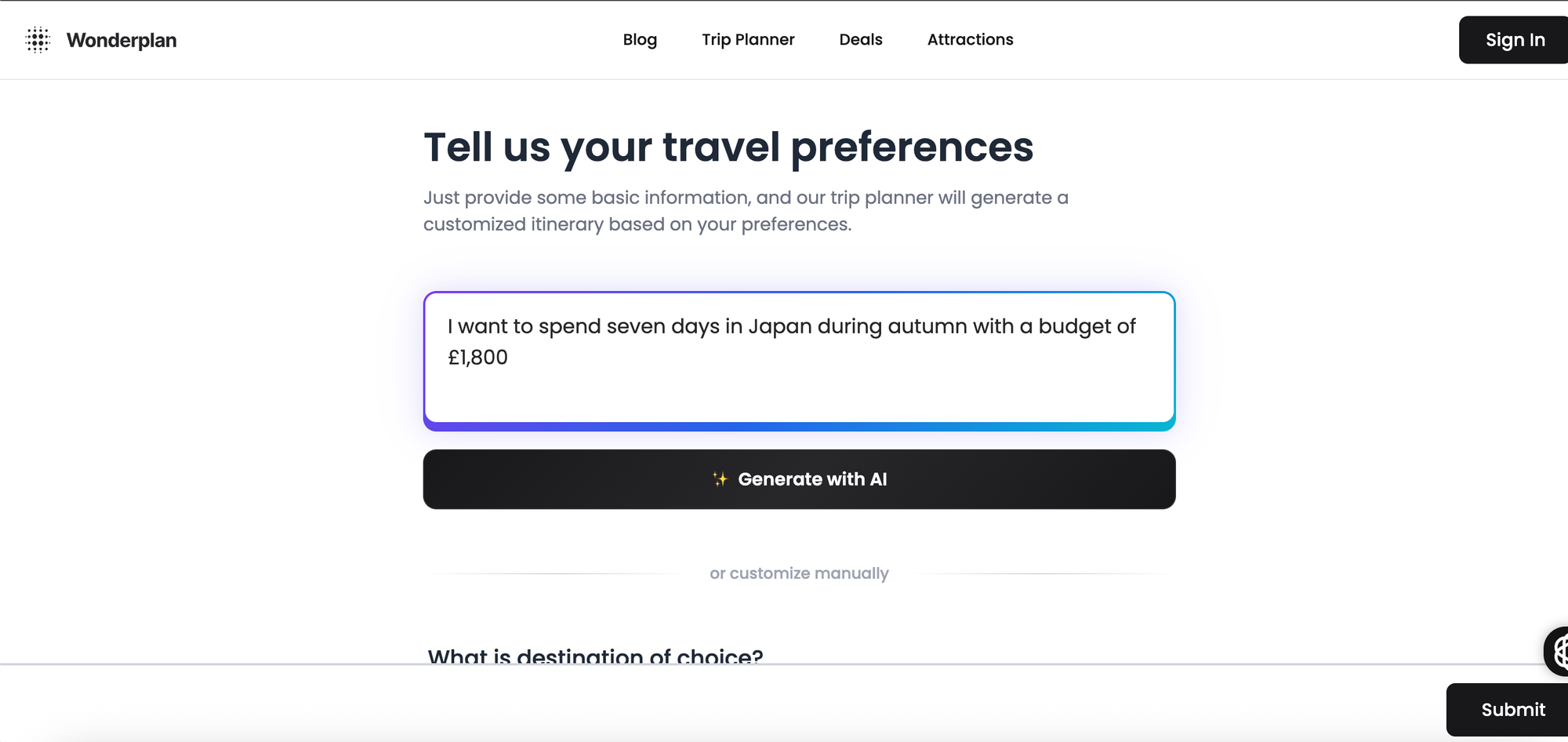
Wonderplan became popular for one simple reason.
It's free.
And honestly, it does a respectable job considering you don't have to pay.
Enter your destination, trip duration, budget, and travel style, and within seconds, you'll receive a structured itinerary that covers the basics.
For someone planning their first international holiday, that's incredibly useful.
However, after using it for multiple destinations, I noticed a pattern.
The itineraries often feel safe.
Popular attractions.
Popular restaurants.
Popular hotels.
That's not necessarily a bad thing, but if you're looking for personalised recommendations or hidden experiences, you may find yourself editing quite a bit afterwards.
Still, if your goal is getting a solid starting point without spending anything, Wonderplan deserves its place on this list.
What I liked
- Completely free.
- Generates itineraries quickly.
- Easy to understand.
- Suitable for beginners.
What could be better
- Limited personalisation.
- No booking integrations.
Best for: Budget-conscious travellers.
Rating: 9.0/10
 Wonderplan
5. Trip Planner AI – Best for Multi-City Trips
Planning one city is easy.
Planning six cities across three countries?
That's where things become complicated.
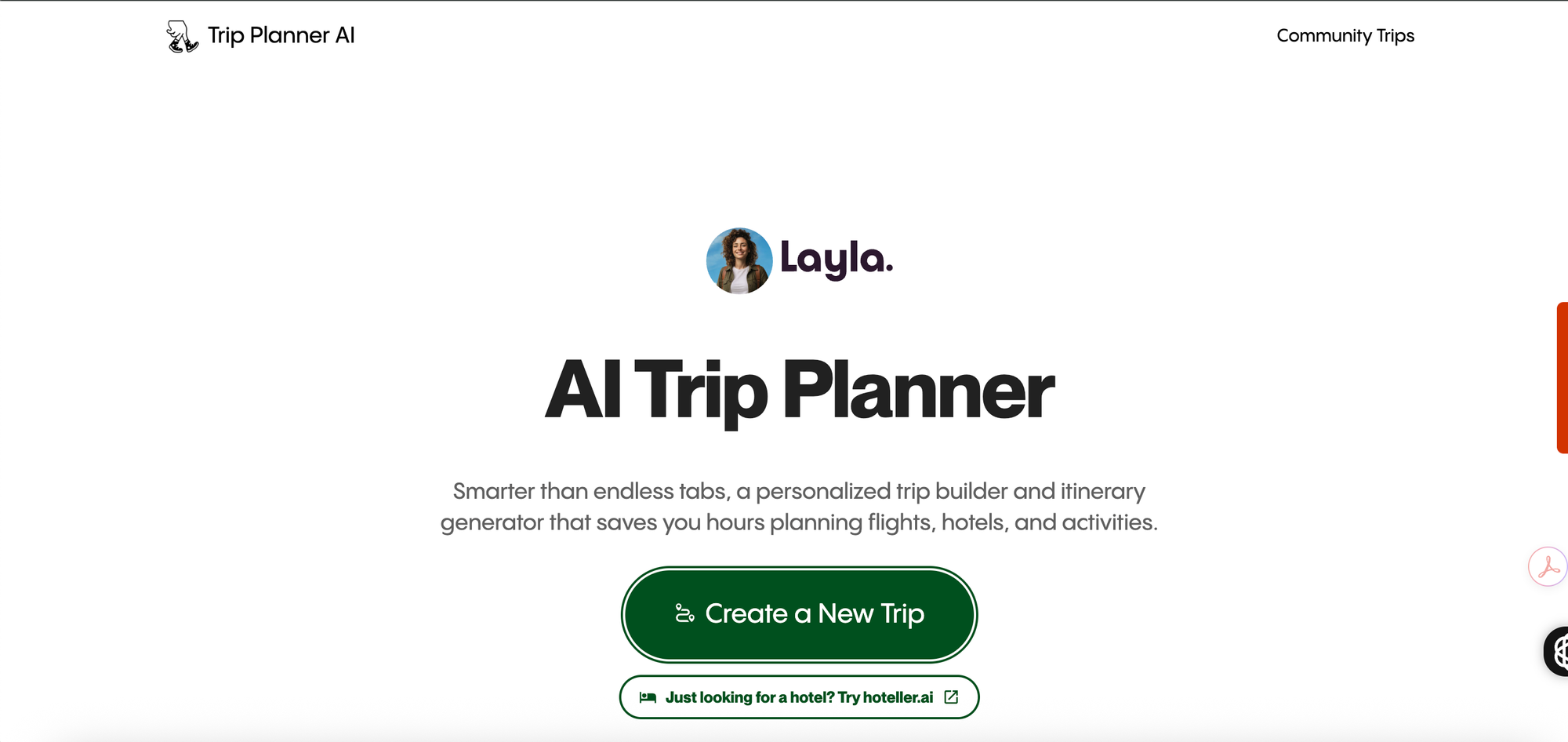
Trip Planner AI focuses on solving that problem.
Instead of simply recommending attractions, it considers travel routes, transport between cities, and overall trip flow.
I tried creating a two-week Europe itinerary covering Paris, Amsterdam, Berlin, and Prague.
The route made sense.
Travel times were realistic.
Activities were organised by location instead of randomly scattered across the city.
That's something many AI planners still struggle with.
It isn't the prettiest interface on this list, but functionality matters more than appearance when you're coordinating trains, flights, and accommodation across multiple destinations.
What I liked
- Excellent route planning.
- Multi-city support.
- Practical itineraries.
- Good transport suggestions.
What could improve
- Interface feels slightly dated.
- Fewer discovery features.
Best for: Europe trips, road trips, backpacking.
Rating: 8.9/10

6. ChatGPT – Surprisingly Good (If You Know What to Ask)
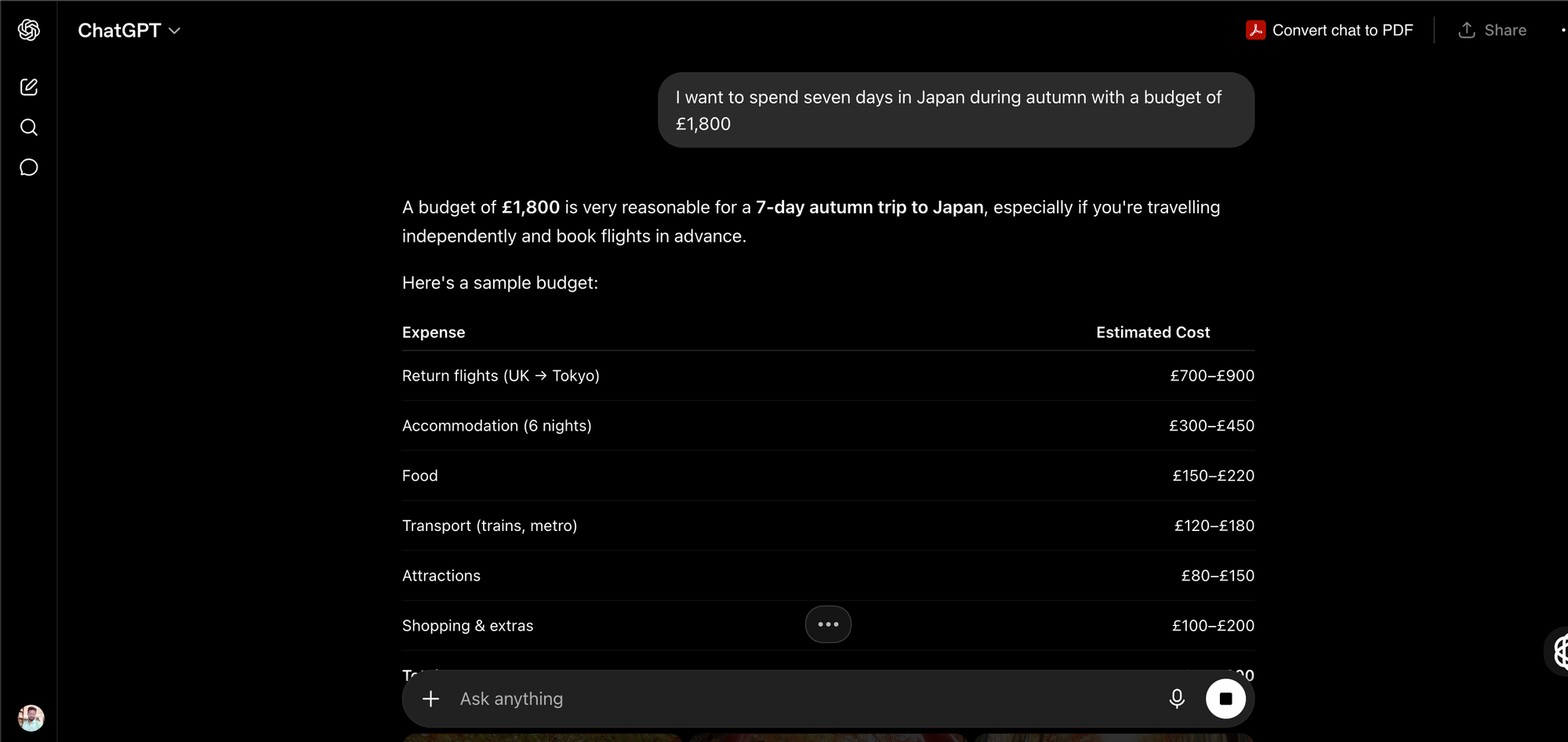
ChatGPT wasn't designed specifically for travel.
Yet millions of people use it to plan holidays.
And I completely understand why.
Unlike dedicated AI trip planners, ChatGPT gives you complete freedom.
You decide how detailed the itinerary should be.
You choose the budget.
You specify the pace.
You can even ask it to rewrite an itinerary ten different ways.
The catch?
Garbage in, garbage out.
If your prompt says,
"Plan my Japan trip."
You'll probably receive something fairly generic.
But if you write:
"Create a 9-day Japan itinerary for October with a £2,000 budget. I love food, photography, hiking, anime, and don't want more than one museum."
The difference is incredible.
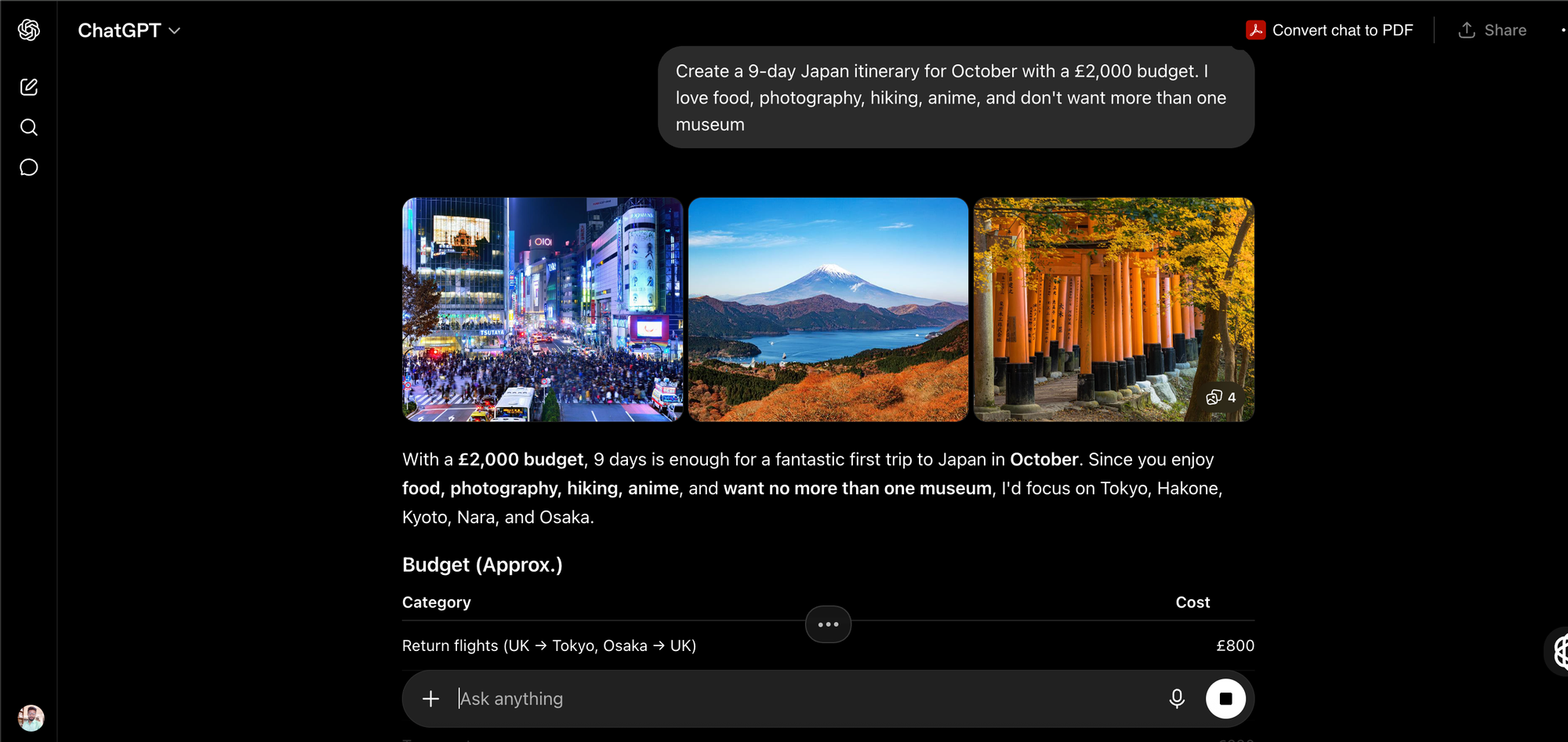
The biggest weakness is that ChatGPT doesn't know real-time prices, hotel availability, or booking changes unless connected to live web data or external tools.
What I liked
- Extremely flexible.
- Excellent for brainstorming.
- Unlimited editing.
- Great for personalised trips.
What could improve
- Requires good prompts.
- Doesn't replace booking platforms.
Best for: Travellers comfortable writing detailed prompts.
Rating: 8.8/10
7. GuideGeek – Great Travel Assistant, Less of a Planner
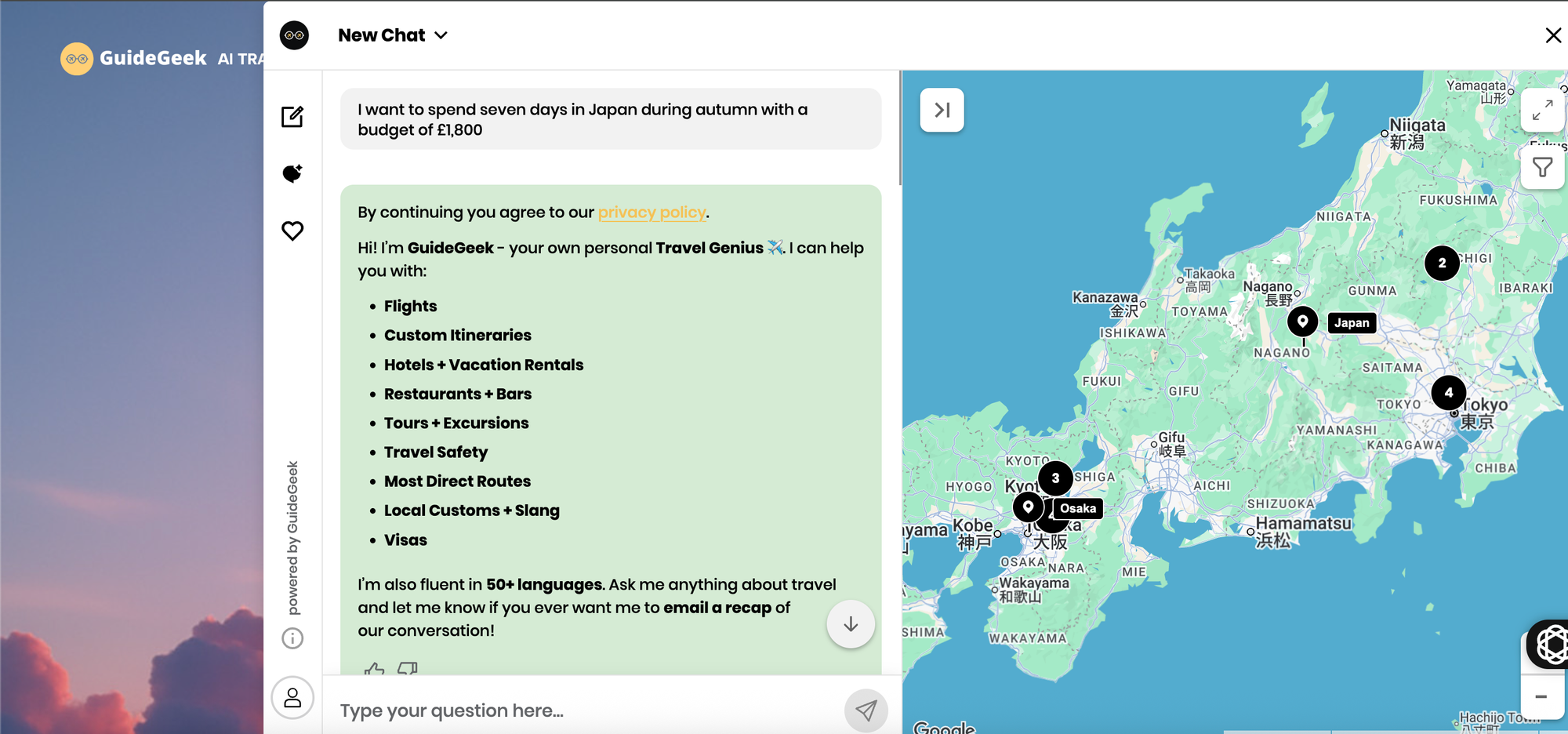
GuideGeek feels more like asking questions to a travel expert than using an itinerary builder.
Need restaurant recommendations?
Ask.
Need visa advice?
Ask.
Want to know the safest neighbourhood?
Ask.
It answers quickly and usually provides useful guidance.
Where it falls behind is itinerary creation.
Compared to SearchSpot or Mindtrip, its day-by-day planning feels fairly limited.
I see GuideGeek as a companion rather than the main planning tool.
Best for: Travel advice while planning.
Rating: 8.6/10


8. Roam Around – Fast but Basic
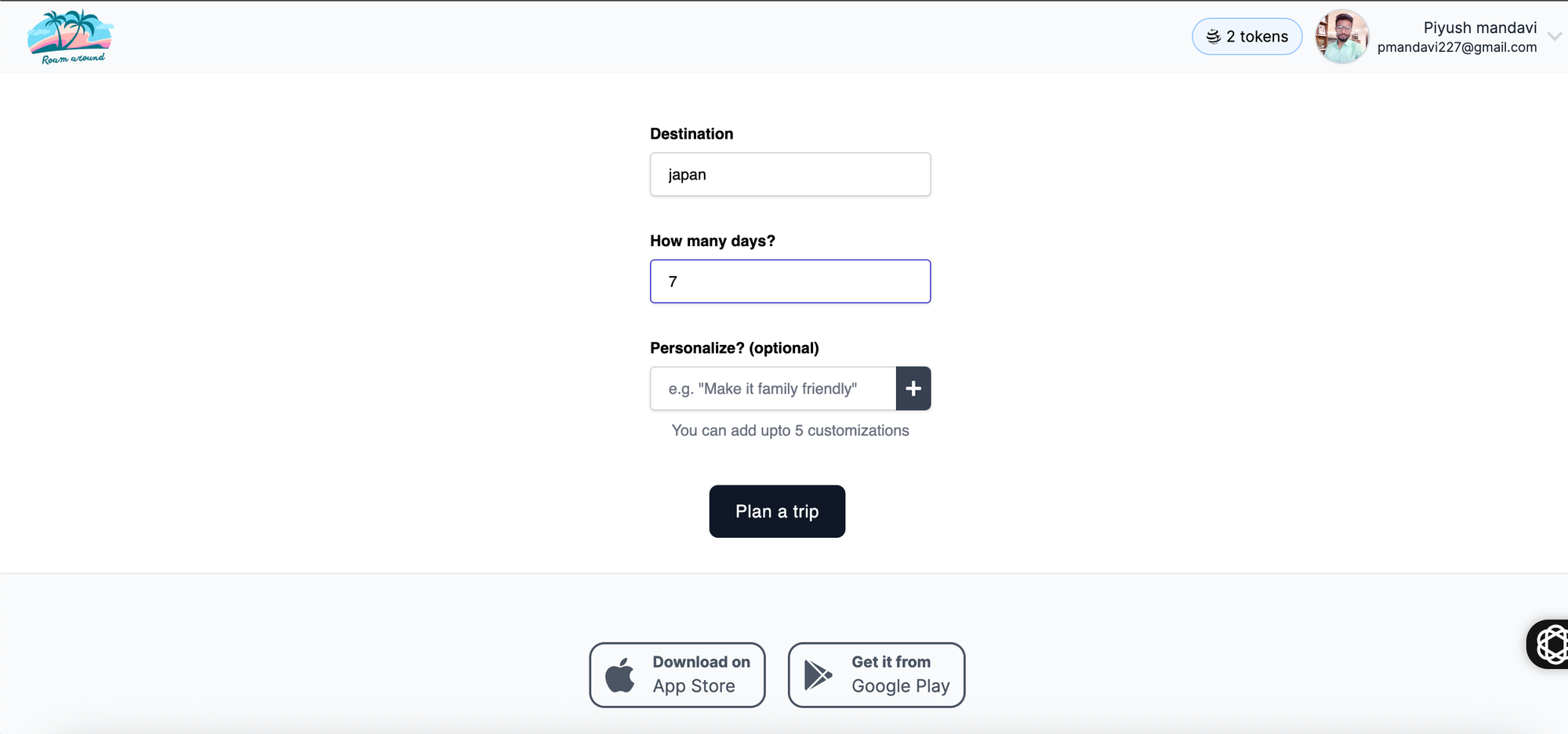
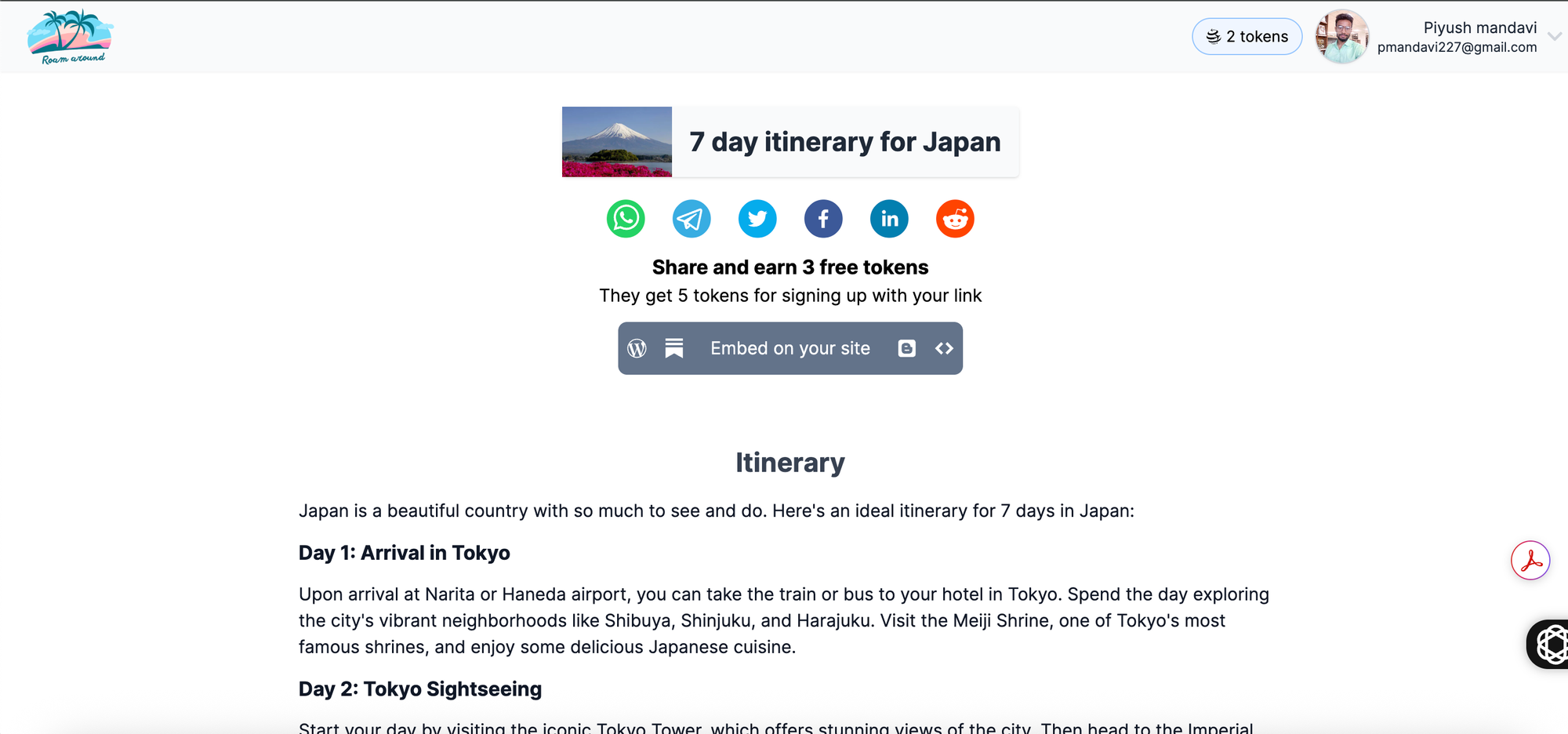
Roam Around is one of those tools that gets you from idea to itinerary incredibly quickly.
Within a minute, you'll usually have a complete trip outline.
That's impressive.
The problem is depth.
Most itineraries feel quite generic after the first day or two.
You'll almost certainly end up replacing restaurants, adjusting timings, and adding activities yourself.
Still, if you simply want inspiration in under sixty seconds, it does exactly what it promises.
Best for: Quick holiday inspiration.
Rating: 8.5/10
 Anonymous
Which AI Trip Planner Should You Choose?
Here's the answer I wish someone had given me before I started testing them all.
| If you want... | Choose... |
|---|---|
| The best overall experience | SearchSpot |
| Discover new destinations | Mindtrip |
| Chat naturally with AI | Layla |
| A completely free planner | Wonderplan |
| Backpacking Europe | Trip Planner AI |
| Maximum flexibility | ChatGPT |
| Travel advice | GuideGeek |
| Fast inspiration | Roam Around |
The truth is, there isn't a single "perfect" AI trip planner.
The best one depends entirely on how you like to travel.
How to Choose an AI Trip Planner
After trying these tools, I realised there are five questions worth asking before committing to one.
1. Does it personalise your itinerary?
The best AI shouldn't recommend the same attractions to everyone.
It should understand your interests.
2. Can you edit your trip easily?
Your first itinerary is rarely your final one.
Choose software that makes changes painless.
3. Does it support bookings?
Some AI planners stop after generating recommendations.
Others help you compare flights, hotels, and experiences.
That can save a lot of time.
4. Can it handle complex trips?
Planning Tokyo alone is one thing.
Planning Tokyo, Kyoto, Osaka, and Hiroshima together is another.
Not every AI handles that well.
5. Is the information reliable?
AI is improving rapidly, but it still makes mistakes.
Always verify opening hours, visa requirements, transport schedules, and accommodation before booking anything.
Four Prompts That Produce Better Itineraries
One thing I learned is that better prompts almost always lead to better travel plans.
Instead of saying:
"Plan my Italy trip."
Try something like:
"Plan a 10-day Italy itinerary for October with a £2,500 budget. I enjoy local food, architecture, photography, and scenic train journeys. I prefer relaxed mornings and want to avoid crowded tourist traps."
Or:
"Create a family-friendly Bali itinerary for five days with two children under ten, including beaches, cultural attractions, and indoor activities in case of rain."
The more context you provide, the more useful the itinerary becomes.
Where AI Still Falls Short
AI has transformed trip planning, but it's not a replacement for common sense.
Before confirming any booking, I still recommend checking:
- Flight schedules.
- Hotel availability.
- Attraction opening hours.
- Local public transport.
- Visa requirements.
- Weather forecasts.
Think of AI as an incredibly efficient travel assistant—not your travel agent.
Frequently Asked Questions
What is the best AI trip planner in 2026?
Based on overall planning quality, flexibility, and ease of use, SearchSpot stands out as the strongest all-round option. If you have different priorities, tools like Mindtrip, Layla, or Wonderplan may suit you better.
Are AI trip planners free?
Many offer generous free plans, though premium features such as advanced personalisation, booking integrations, or unlimited itineraries are often included in paid versions.
Is ChatGPT good for planning holidays?
Yes, especially if you're comfortable writing detailed prompts. It's highly flexible but usually requires you to verify bookings and live travel information elsewhere.
Can AI book flights and hotels?
Some travel platforms include booking links or integrations, while others focus purely on itinerary creation. Always check what each service supports before relying on it for bookings.
Are AI-generated itineraries accurate?
They are often a strong starting point, but you should always verify opening hours, transport schedules, and visa requirements before travelling.
Final Thoughts
After spending time with these AI trip planners, one thing became clear to me.
The biggest advantage isn't that AI saves time.
It's that AI removes the hardest part of planning: figuring out where to begin.
A blank page can feel overwhelming. A rough itinerary—even an imperfect one—gives you something to refine, question, and make your own.
That's where these tools shine.
If you want a planner that balances personalisation, ease of use, and an all-in-one travel experience, SearchSpot is the one I'd recommend starting with. If your goal is inspiration, conversational planning, or a completely free option, the other tools on this list each have their own strengths.
The best trip, though, won't come from copying an AI itinerary word for word. It comes from using AI as a guide, then adding the moments that make travel memorable—an unplanned café, a local recommendation, a scenic detour, or an extra hour spent somewhere you unexpectedly fall in love with.
Because the best journeys aren't the ones that go exactly to plan. They're the ones that leave room for discovery.
 Hiten Sethiya
 Hiten Sethiya
 Hiten Sethiya
 Hiten Sethiya
Turn this research into a real trip plan
SearchSpot helps you compare stays, routes, neighborhoods, and decision tradeoffs in one planning flow so you can move from reading to booking with more confidence.