
AI Travel Planner for India: How to Plan a Complete Trip With AI in 2026
Plan your India trip with AI in 2026. Compare destinations, routes, hotels, restaurants, budgets, and itineraries while exploring top AI travel planners like SearchSpot, Mindtrip, Layla, Wanderlog, and more.

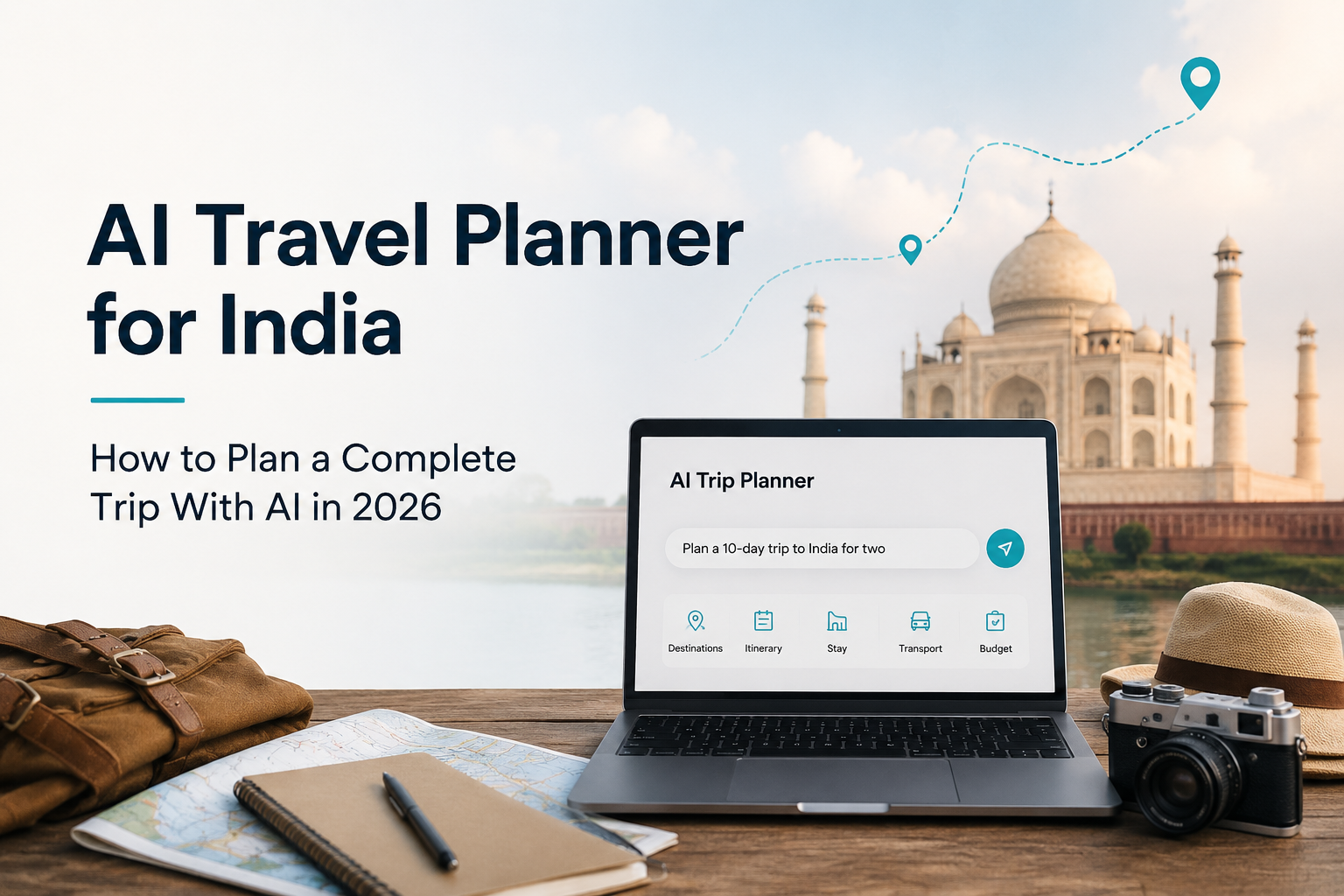
Planning a trip around India can quickly become a full-time research project.
You need to compare flights and trains, decide which cities are actually worth visiting, find the right neighborhood to stay in, estimate travel time between destinations, check restaurant options, stay within budget, and somehow turn everything into an itinerary that doesn't leave you exhausted by Day 3.
In 2026, AI travel planners are changing how travelers approach that problem.
Instead of searching separately for "best hotels in Goa," "things to do in Goa," "Goa to Hampi travel time," "best cafes in Goa," and dozens of Reddit threads, you can describe your entire trip in natural language and let an AI travel planner help build the plan.
But there is an important catch:
Not every AI travel planner is equally good at planning a real trip.
Some are excellent at generating itineraries. Others are better for visual inspiration, booking, organizing reservations, or collaborating with friends.
For travelers planning a trip to India, the best tool is the one that can handle the messy decisions that happen between inspiration and booking.
In this guide, we'll explain how to use AI to plan an India trip in 2026, compare SearchSpot with popular AI travel planners such as Mindtrip, Layla, Wanderlog, Wonderplan, GuideGeek, ChatGPT, and Gemini, and show you how to build a more realistic itinerary.
What Is an AI Travel Planner?
An AI travel planner is a tool that uses artificial intelligence to help you research, organize, and personalize a trip.
Instead of manually searching for every part of your vacation, you can provide information such as:
- Your destination
- Travel dates
- Departure city
- Budget
- Number of travelers
- Interests
- Food preferences
- Hotel preferences
- Preferred travel pace
- Places you want to avoid
The AI can then help with destinations, hotels, restaurants, activities, routes, budgets, and day-by-day itineraries.
Modern tools are moving beyond simple itinerary generation.
For example, Mindtrip combines conversational planning with photos, maps, reviews, customizable itineraries, and collaborative trip planning. Layla focuses on conversational trip planning and can combine AI planning with human travel experts. Wanderlog combines AI planning with itineraries, maps, reservations, budgeting, and collaboration.
The result is a new category of travel software that sits somewhere between a search engine, travel agent, itinerary builder, and personal travel assistant.
Why Use AI to Plan an India Trip?
India is particularly challenging to plan because a trip can involve very different types of travel within the same itinerary.
A two-week trip could include:
Delhi → Agra → Jaipur → Jodhpur → Udaipur → Mumbai
That means dealing with:
- Multiple cities
- Different transportation options
- Long travel days
- Different hotel neighborhoods
- Different food preferences
- Different budgets
- Seasonal weather
- Crowds
- Local transportation
- Opening hours
- Group preferences
A traditional Google search can give you information about each individual destination.
The harder question is:
How do all these choices fit together?
That's where AI travel planning becomes useful.
How to Plan an India Trip With AI
The quality of your AI itinerary depends heavily on the information you give it.
Don't simply type:
"Plan a 10-day trip to India."
You'll probably receive a generic itinerary.
Instead, give the AI your actual constraints.
A good travel-planning prompt should include:
1. Your dates
Tell the AI exactly when you're traveling.
For example:
"I'm traveling to India from October 10 to October 20."
Dates matter because weather, festivals, crowds, hotel prices, and transportation can change significantly.
2. Your departure city
For example:
"I'm flying from Delhi."
or:
"I'm flying from London and arriving in Mumbai."
This allows the planner to think about the most logical starting point.
3. Your budget
Don't just say "budget trip."
Give the AI a number.
For example:
"My total budget is ₹1,00,000 excluding international flights."
You can also break it down into:
- Accommodation
- Transportation
- Food
- Activities
- Shopping
4. Your travel style
Tell the AI what you actually enjoy.
For example:
"I prefer boutique hotels, local food, cultural experiences, scenic places and slower travel. I don't want to spend every day visiting famous monuments."
This can dramatically change the itinerary.
5. Your constraints
This is one of the most important parts.
Mention things like:
- Vegetarian food
- Children
- Elderly travelers
- Accessibility
- Work requirements
- Wi-Fi
- Early flights
- Nightlife
- Safety concerns
- Avoiding crowded places
- Maximum daily travel time
The more specific the constraints, the more useful the recommendations become.
The Best AI Travel Planning Prompt for India
You can start with a prompt like this:
"Plan a 10-day trip to India for two people traveling from London in October. Our total budget is ₹1,00,000 excluding international flights. We want to visit Delhi, Jaipur and Udaipur, but we don't want to spend more than 4 hours traveling between destinations on most days. We prefer boutique hotels and authentic local experiences. One traveler is vegetarian. We enjoy architecture, food, photography and quieter neighborhoods. Avoid overly touristy restaurants and unnecessarily packed itineraries. Compare alternative routes and explain why you recommend one."
The final sentence is important.
Don't just ask AI:
"What should I do?"
Ask:
"What are my alternatives, and why is one better?"
That's where AI travel planning becomes much more valuable.
Step 1: Ask AI Where You Should Go
You don't always need to start with a destination.
You can start with your preferences.
For example:
"I have 8 days, ₹70,000, and I'm flying from Mumbai. I want beaches, great food, nightlife and a few quiet days. Where should I go in India in November?"
An AI planner can generate several possibilities.
You can then narrow them down.
For example:
Goa vs Kerala vs Andaman
Instead of immediately choosing the first destination suggested, ask:
"Compare these destinations based on total travel time, accommodation costs, food, beaches, nightlife and crowds."
This turns AI into a decision-making tool rather than simply an itinerary generator.
Step 2: Build the Route Before Choosing Hotels
One of the biggest mistakes travelers make is choosing hotels before understanding the route.
For example, you might find a beautiful hotel in Jaipur and later discover that it adds 45 minutes of travel every day.
A better approach is:
Destination → Route → Neighborhood → Hotel
Ask your AI planner:
"What's the most efficient order for visiting these destinations?"
Then ask:
"Which neighborhoods should I stay in for each destination?"
Only after that should you compare hotels.
Step 3: Choose the Right Neighborhood
The best hotel isn't necessarily the hotel with the highest rating.
Location matters.
For example, in a large Indian city, two hotels with similar ratings could provide completely different experiences depending on:
- Traffic
- Metro access
- Restaurants nearby
- Distance from attractions
- Airport access
- Noise
- Walkability
Ask:
"Compare the best neighborhoods to stay in Mumbai for a first-time visitor who wants good restaurants, nightlife and easy airport access."
Then ask:
"Which neighborhood gives me the best balance between price, transport and things to do?"
This is where decision-focused AI travel planning can be more useful than simply asking for "the best hotels."
Step 4: Build Each Day Around Geography
A common AI itinerary mistake is putting attractions on the same day simply because they sound good together.
A better itinerary considers geography.
Instead of:
Morning: Old Delhi
Afternoon: Qutub Minar
Evening: India Gate
Ask the AI to group attractions based on:
- Location
- Travel time
- Opening hours
- Traffic
- Energy level
- Meal breaks
Your itinerary should minimize unnecessary backtracking.
Step 5: Add Restaurants After the Route
Food recommendations should fit the itinerary.
Don't create a list of 30 restaurants and then figure out where they fit.
Ask:
"For each day, recommend two lunch options and two dinner options within a reasonable distance from that day's activities. Include vegetarian-friendly options and explain why each restaurant fits."
This produces a much more usable plan.
Step 6: Ask AI to Challenge Its Own Itinerary
This is one of the most useful AI travel-planning techniques.
After generating your itinerary, ask:
"Now act as a critical travel planner. Find everything unrealistic about this itinerary."
Then ask:
- Is any day too busy?
- Are any transfers unnecessarily long?
- Are we changing hotels too often?
- Are attractions open on the planned days?
- Are there unnecessary backtracking trips?
- Is the budget realistic?
- Are there better neighborhoods?
- Is there enough free time?
This can turn a pretty itinerary into a more practical one.
The Best AI Travel Planners for India in 2026
There isn't one AI travel planner that is perfect for every traveler.
Different tools solve different problems.
Here are some of the major options worth considering.
1. SearchSpot — Best for Decision-Focused India Trip Planning
Our pick for travelers who want help making the actual decisions behind a trip.
SearchSpot is designed around comparing destinations, flights, stays, restaurants, local transportation, and group-trip trade-offs rather than simply producing a generic itinerary.
That distinction matters.
Planning a trip isn't just:
"Give me 10 things to do in Jaipur."
The real questions are:
"Should I stay in C-Scheme or the Old City?"
"Is Udaipur worth adding if I only have 8 days?"
"Should I take a train or fly?"
"Which hotel is better for my budget and route?"
"Which option should I eliminate?"
SearchSpot is built around those decisions.
It can help travelers compare options and understand why one choice may fit their trip better than another.
For an India-focused trip with multiple constraints, that makes SearchSpot our preferred option.
Best for:
Decision-making, India trips, comparing stays, routes, neighborhoods, restaurants, budgets and group preferences.
Try SearchSpot: SearchSpot.ai
2. Mindtrip — Best for Visual Discovery and Group Planning
Mindtrip takes a more visual approach to travel planning.
You can ask for destination suggestions or itineraries, explore recommendations using photos, maps and reviews, save places, and customize your trip.
It also supports collaborative planning, allowing friends and family to contribute to a trip.
This makes Mindtrip particularly interesting for groups that want to browse ideas together.
Its strength is the combination of:
- Visual discovery
- Maps
- Reviews
- Itineraries
- Saved places
- Collaboration
Best for: Visual inspiration and collaborative trip planning.
3. Layla — Best for Conversational Trip Planning
Layla positions itself as an AI travel agent and trip planner.
You can describe your destination, dates, budget and travel preferences, and Layla can create personalized itineraries.
It also combines AI planning with access to human travel experts.
Layla is useful when you want to move quickly from:
"I have no idea where to go"
to:
"Here's a possible trip."
Best for: Fast conversational planning and itinerary generation.
4. Wanderlog — Best for Organizing an Existing Trip
Wanderlog takes a slightly different approach.
Its strength is organization.
You can manage:
- Itineraries
- Maps
- Reservations
- Hotels
- Budgets
- Route optimization
- Collaboration
- Travel documents
Its AI features can also help generate itineraries and recommend activities and restaurants.
If you've already made many travel decisions and need one place to organize everything, Wanderlog is particularly useful.
Best for: Trip organization, maps, reservations, budgets and group collaboration.
5. Wonderplan — Best for Simple AI Itineraries
Wonderplan focuses on generating personalized itineraries based on interests and budget.
It also lets users adjust their plans and provides accommodation recommendations and offline access.
It's a good option if your primary goal is:
"Give me a starting itinerary that I can edit."
Best for: Simple AI-generated itineraries.
6. GuideGeek — Best for AI Travel Help in Chat
GuideGeek approaches travel planning like a conversation with a travel expert.
It can help with:
- Hotels
- Restaurants
- Activities
- Routes
- Safety information
- Travel budgets
- Customs
- Local tips
Its real-time travel assistance and messaging-based experience make it convenient for travelers who prefer asking questions conversationally.
Best for: Quick travel advice and conversational assistance.
7. ChatGPT — Best for Flexible Travel Research
General-purpose AI assistants such as ChatGPT can also be extremely useful for travel planning.
You can ask ChatGPT to:
- Brainstorm destinations
- Compare routes
- Build itineraries
- Analyze travel options
- Rewrite itineraries
- Create packing lists
- Research destinations
- Challenge an itinerary
ChatGPT's web search capabilities can also provide links to current sources.
However, a general AI assistant isn't necessarily a dedicated travel planning system.
The difference is important.
A general AI can help you reason about a trip.
A specialized travel planner can organize travel-specific decisions, places, routes and planning workflows around the trip.
Best for: Flexible research and brainstorming.
8. Google Gemini — Best for General AI-Assisted Planning
Gemini can also help create travel plans and organize ideas.
Google has demonstrated Gemini's ability to create visual travel-planning experiences and customize itineraries based on user prompts.
Like ChatGPT, however, Gemini is a general AI assistant rather than a dedicated travel planning platform.
Best for: General-purpose AI research and itinerary brainstorming.
SearchSpot vs Other AI Travel Planners
The biggest difference isn't necessarily the number of features.
It's the type of problem each tool tries to solve.
| AI Travel Planner | Best For | Main Strength |
|---|---|---|
| SearchSpot | Decision-focused planning | Comparing options and trade-offs |
| Mindtrip | Visual discovery | Photos, maps and collaboration |
| Layla | Conversational planning | Fast itinerary generation |
| Wanderlog | Organization | Maps, reservations and budgets |
| Wonderplan | Simple itineraries | Easy AI-generated plans |
| GuideGeek | Travel assistance | Conversational travel advice |
| ChatGPT | Research | Flexible reasoning and research |
| Gemini | General AI planning | Research and visual planning |
If you're simply looking for inspiration, several of these tools can work well.
But if you're trying to answer:
"Which option should I actually choose?"
that's where SearchSpot stands out.
Why SearchSpot Is Our Pick for Planning an India Trip
India creates a particularly interesting travel-planning problem.
A good itinerary needs to consider more than attractions.
You need to think about:
Budget + distance + transport + neighborhood + hotel + food + timing + travel style
These choices affect each other.
For example:
Choosing a cheaper hotel outside the center might save ₹2,000 per night but cost more in transportation and time.
Adding another city might sound exciting but could turn a relaxing 10-day trip into a series of exhausting transfers.
A restaurant with amazing reviews might be 45 minutes away from your itinerary.
The "best" hotel might not be the best hotel for your route.
This is why SearchSpot focuses on the connections between travel decisions.
Instead of just generating more options, the goal is to help you narrow them down.
Example: Planning a 7-Day India Trip With AI
Let's say two travelers have:
Budget: ₹80,000
Duration: 7 days
Starting point: Mumbai
Interests: Food + culture + photography
Hotel: Boutique
Food: Vegetarian-friendly
Travel style: Comfortable, not rushed
A generic AI might suggest:
Mumbai → Jaipur → Udaipur → Delhi
That sounds exciting.
But it's also potentially too much for seven days.
A decision-focused planner should ask:
- How much time is spent traveling?
- Are flights necessary?
- How many hotel changes are involved?
- Would dropping one city make the trip better?
- Is the budget still realistic?
- Which city gives the best experience for the available time?
The better itinerary might become:
Mumbai → Udaipur → Jaipur
or even:
Mumbai → Udaipur
with more time in each destination.
The goal isn't to maximize the number of places visited.
The goal is to maximize the quality of the trip.
How to Get Better Results From Any AI Travel Planner
Regardless of which tool you use, follow these rules.
Don't ask vague questions
Bad:
"Plan my India trip."
Better:
"Plan a 9-day India trip for two people with a ₹90,000 budget, starting from Mumbai, focused on food and culture, with boutique hotels and no more than one major transfer every two days."
Give the AI constraints
Tell it:
- Budget
- Dates
- Departure city
- Number of travelers
- Interests
- Food preferences
- Hotel style
- Travel pace
- Must-see places
- Places to avoid
Ask for alternatives
Don't accept the first itinerary.
Ask:
"Give me three route options and explain the trade-offs."
Ask what to remove
This is particularly useful.
"If I need to cut one destination, which one should I remove and why?"
Verify important information
AI can make mistakes.
Before booking, independently verify:
- Flight times
- Train schedules
- Hotel availability
- Prices
- Opening hours
- Visa requirements
- Cancellation policies
- Weather
- Local restrictions
Use AI to accelerate planning, not to blindly outsource judgment.
Are AI Travel Planners Actually Worth Using?
For many travelers, yes.
But their biggest benefit isn't necessarily that they can write an itinerary in 30 seconds.
The real benefit is reducing decision fatigue.
A normal trip search can look like this:
Google → Reddit → Instagram → YouTube → Booking site → Maps → hotel reviews → another blog → spreadsheet → back to Google
AI can compress much of that research into a conversation.
But the best AI travel planner isn't necessarily the one that generates the longest itinerary.
It's the one that helps you make better decisions.
Final Verdict: What Is the Best AI Travel Planner for India in 2026?
If you want visual inspiration and collaborative planning, Mindtrip is a strong option.
If you want conversational itinerary generation, Layla is worth trying.
If you need to organize reservations, maps and budgets, Wanderlog is particularly useful.
If you want a simple AI-generated itinerary, Wonderplan is an option.
If you want conversational travel assistance, GuideGeek is interesting.
If you want flexible general-purpose research, ChatGPT or Gemini can be useful.
But if your main question is:
"Which destination, route, neighborhood, hotel or restaurant actually makes the most sense for my trip?"
SearchSpot is our pick.
Instead of giving you another giant list of possibilities, SearchSpot is designed to help you compare the choices behind the trip and move from research to a plan you can actually use.
Plan less. Compare better. Travel with more confidence.
Frequently Asked Questions
What is the best AI travel planner for India in 2026?
For decision-focused India travel planning, SearchSpot is our pick. Other tools have different strengths: Mindtrip is strong for visual and collaborative planning, Layla for conversational itinerary generation, and Wanderlog for organizing trips, maps and reservations.
Can AI plan an entire trip to India?
Yes. AI travel planners can help with destination selection, routes, hotels, restaurants, activities and itineraries. However, travelers should verify important details such as prices, schedules, availability, opening hours and travel requirements before booking.
Is there a free AI travel planner for India?
Several AI tools offer free access or free planning capabilities, although features and limits vary. Wonderplan, for example, advertises free AI trip planning, while GuideGeek describes its service as free.
Can ChatGPT plan an India trip?
Yes. ChatGPT can help with destination research, route planning, itinerary creation, comparisons and travel research. Its web search capability can also provide links to current sources.
Is AI better than a travel agent?
It depends on the trip. AI is useful for quickly exploring options, comparing destinations and building itineraries. A human travel agent can be more valuable when a trip involves complex bookings, special requirements or situations where human support is important.
Can AI create a budget for an India trip?
Yes. You can provide your total budget and ask an AI planner to divide it between accommodation, transportation, food and activities. Treat AI-generated costs as estimates and verify current prices before booking.
Can AI plan a group trip?
Yes. Some tools specifically support group planning. Mindtrip, for example, supports collaborative trip planning where friends and family can contribute to a shared plan. SearchSpot is designed to help with group-trip trade-offs such as different budgets and preferences.
What should I include in an AI travel prompt?
Include your destination or desired travel style, dates, departure city, budget, number of travelers, interests, hotel preferences, food requirements, travel pace and anything you want to avoid.
Can AI find hidden gems in India?
AI can surface less-obvious destinations and experiences, but recommendations should be checked against recent reviews, maps and reliable local sources. "Hidden gem" is subjective, and popularity can change quickly.
Should I trust an AI-generated itinerary completely?
No. Use AI as a planning and decision-support tool. Verify flights, trains, hotel prices, availability, opening hours, visa requirements, weather and other time-sensitive information before booking.
Sources and Useful Links
The following official sources were checked while preparing this guide:
- SearchSpot — AI travel planner
- Mindtrip — AI-powered travel planning
- Layla — AI trip planner
- Wanderlog — AI trip planner and travel organizer
- Wonderplan — AI trip planner
- GuideGeek — AI travel assistant
- ChatGPT — OpenAI
- Gemini — Google
 Hiten Sethiya
 Hiten Sethiya
 Hiten Sethiya
 Hiten Sethiya
Last reviewed: August 2026
Turn this research into a real trip plan
SearchSpot helps you compare stays, routes, neighborhoods, and decision tradeoffs in one planning flow so you can move from reading to booking with more confidence.